Customize the display
Adjust the colors to ensure sufficient contrast.

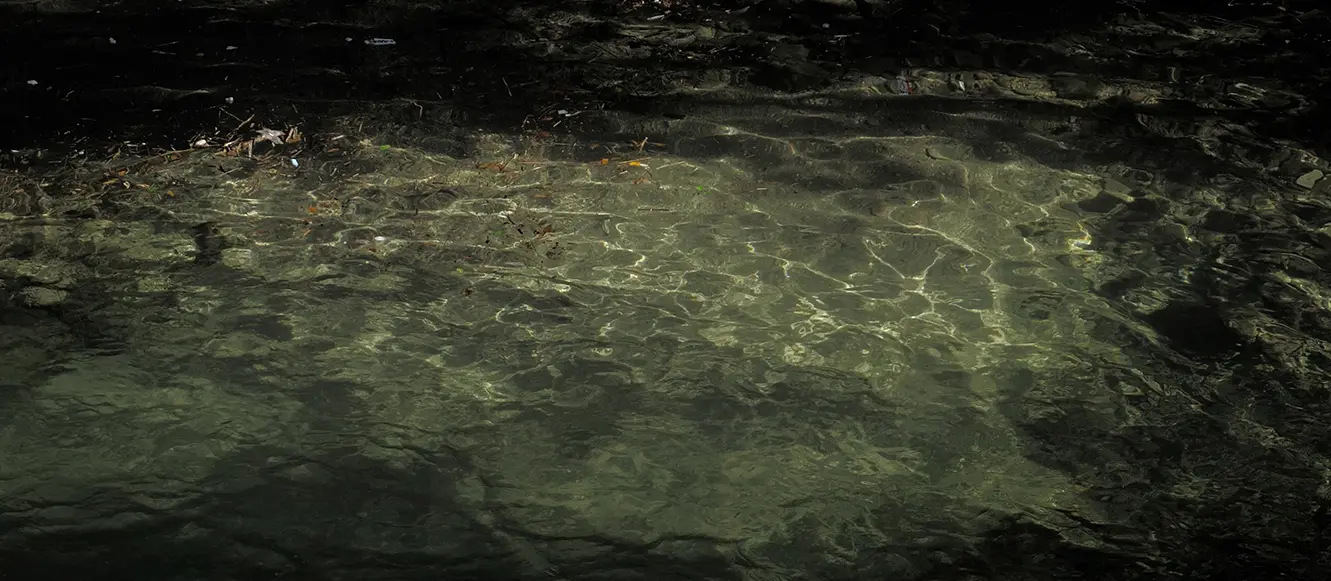
As part of La Fête du Ruisseau
"Invisible Rivers" is part of the "Rivières*" regional project, led by GMEM and OSU-Pythéas, the Observatory of Universe Sciences. This collaboration has given rise to a shared goal: to make Marseille’s rivers—the Huveaune, the Jarret, and the Aygalades—visible and tangible once again.
The Rivières project brings together an artistic team and a scientific team to explore, experiment with, and imagine new forms of expression at the intersection of scientific knowledge and experimental sound creation.
As part of this initiative, the “Invisible Rivers” project features a reading of the philosophical text “The Missing Piece,” written and read by Antoine Devillet, which connects the history of Marseille’s waterways to global geopolitical issues surrounding the appropriation of water. The performance will be accompanied by a mixed musical improvisation blending vibraphone and electronic sounds. Sound thus becomes a space for exploration and resonance, offering a different way to hear these rivers, their histories, their transformations, and the landscapes they traverse, while highlighting the importance of water as a precious resource.
*Following *Sans Nom Dit*, *Pétrole*, *Les Pupitres de la Cayolle *, and *Sonord*, theGMEM presents its new regional art project:*Rivières*.
Mentions
Fête du Ruisseau:
Partnership
Collectif des Gammares;GR 2013 Guides Office
Rivières Project:
Co-production
GMEM—National Center for Musical Creation; OSU Pythéas (Observatory of Sciences of the Universe): AMU/CNRS/INRAE/IRD; IMBE (Mediterranean Institute for Biodiversity and Marine and Continental Ecology): CNRS/IRD; EcoComplex-Biodiv Thematic School.
Support
PEPR ICCARE—priority research program and equipment dedicated to the cultural and creative industries, led by the CNRS.
Partnership
Collectif des Gammares;GR 2013 Guides Office
Rivières Project:
Co-production
GMEM—National Center for Musical Creation; OSU Pythéas (Observatory of Sciences of the Universe): AMU/CNRS/INRAE/IRD; IMBE (Mediterranean Institute for Biodiversity and Marine and Continental Ecology): CNRS/IRD; EcoComplex-Biodiv Thematic School.
Support
PEPR ICCARE—priority research program and equipment dedicated to the cultural and creative industries, led by the CNRS.




This work received government funding administered by the National Research Agency under the France 2030 program, grant number ANR-23-PEIC-0001.
Biography(s)
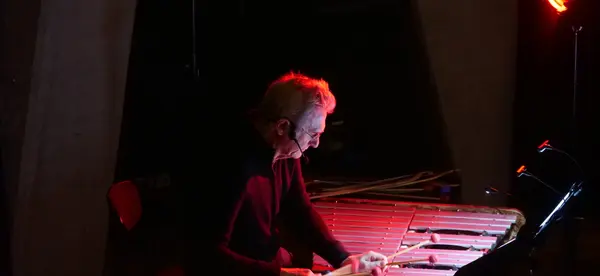
Alex Grillo
Composer, vibraphonist
His career is a crossing of musical genres: jazz, learned music, traditional or innovative, written or improvised.
Christian Sebille
Composer
Appointed in 2011 as director of the GMEM, the National Center for Musical Creation in Marseille, Christian Sebille serves in the dual roles of director and composer.
Beginning in 1983, he devoted himself to electroacoustic music, which he studied with Jean Schwartz (Gennevilliers Conservatory) and Philippe Prévost (IRCAM), and then, in 1987, to mixed media music at La Muse en Circuit with Luc Ferrari.
In 1993, he founded Césaré in Reims, which became the National Center for Musical Creation in 2006 and whose artistic direction is focused on openness and the convergence of artistic disciplines and styles.
Christian Sebille’s catalog includes more than seventy vocal, instrumental, electroacoustic, and mixed-media works. Beginning in 1998, he developed computer-based instrument design, which allowed him to explore the fields of improvisation and real-time performance both in France and abroad. (Alex Grillo, Philippe Foch, Matt Bourne, Miquèu Montanaro…). From 2002 to 2013, he created a large-scale series of musical installationstitled *Les 13 miniatures*, in which he explored the concepts of space and landscape—elements that have since characterized and defined his artistic practice.
Since 2009, a series titled*Les concerts radiophoniques* has involved staging performances in which all electroacoustic elements (interviews, sound recordings, real-time processing, sound effects) are combined with the presence of musicians to create a live radio production. The most recent ones, created with Philippe Foch (percussion), juxtaposed the two industrial sites of Donges (Pays de Loire) and Martigues (Étang de Berre). The most recent piece was commissioned and presented as part of the DigitIZMir festival (Izmir, Turkey) in 2024.
Since 2018, Christian Sebille, in residence at CIRVA (International Center for Research on Glass and Art), has been working onthe project*Paysage de Propagations*, a series of projects that takes on a wide variety of presentation formats, such as installations, performances, and concerts.
Since 2022, he has been creating a series of performed electronic pieces. The first was commissioned by the Chaillol Cultural Center (Le chant des cimes); the second, *Embrasser un arbre embrasserle temps* (2022–2025), is a landscape performance with choreographer Emmanuelle Huynh in which the question of landscape and space remains central.
In 2025, Christian Sebille will create *En voiture, une Musique-Fiction* (a series for an ambient sound installation—IRCAM-Centre Pompidou) based on an original text by Olivia Rosenthal.
Location
13015
Marseille
City of Street Arts
225 Ibrahim Ali Ave.13015
Marseille
Invisible Rivers
Stream Festival
Performance
Regional Development Plan
Sun., Oct. 4, 2026 | 3:00 p.m.
Cité des arts de la rue
Runtime
, 35 min.
Open to the public; no reservation required
Distribution
Artistic team
, featuring
, Alex Grillo
, percussion
Christian Sebille
electronics
, Antoine Devillet
, writing, readings
Useful links
You will also like...