
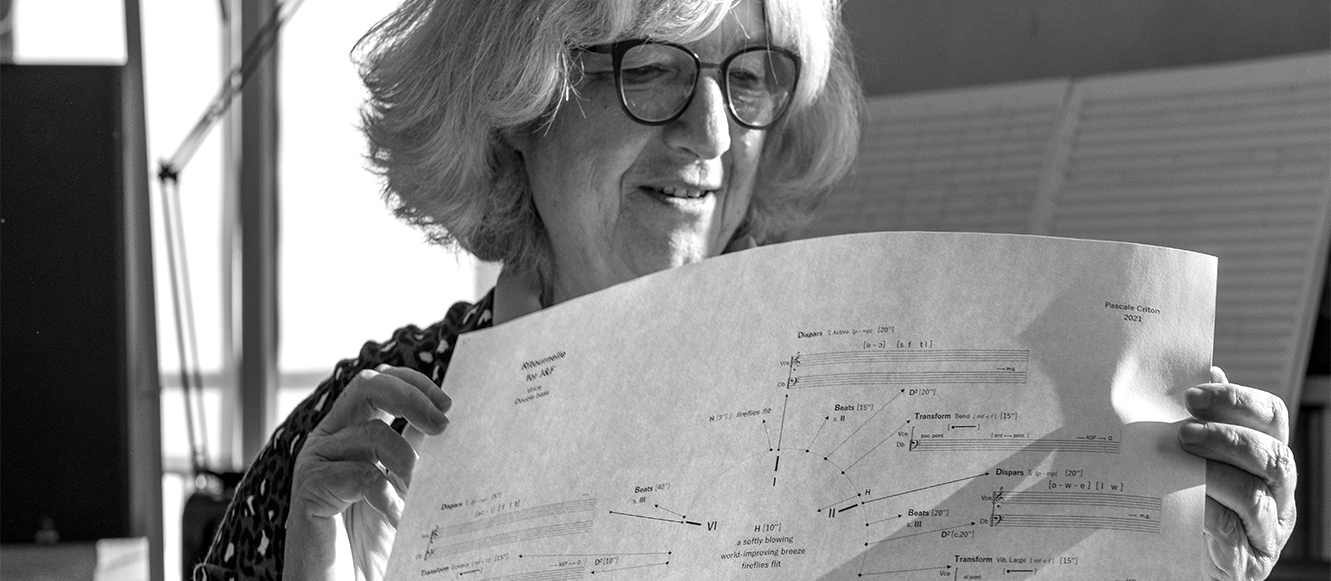

"The musical gesture is sensitive to changing, unpredictable variations, so that a dynamic, gestural choreography haunts a score. The instrumental gesture then tends towards the expression of a force that unfolds and rewinds ceaselessly, stretching and deepening, accelerating and restarting: a desired encounter with the unexpected. It's no longer a question of fixed notes, but of multiple states and intensities of movement. For me, this plasticity evokes the play of inflection present in the voice, in words, but also in thoughts, sensations, bodies and the perception of the world around us." Pascale Criton
Inflexions is a set of pieces with changing, unpredictable variations.
The singer uses a connected ring to manage her relationship with the sound events interwoven with the spoken and sung words, integrating a degree of invention and uncertainty into the performance. A force unfolds and rewinds again and again, stretching and deepening, accelerating and restarting.
These are no longer fixed notes, but a choreography of sound in multiple states and intensities.
Statement of Intent
OUT (2015 — 8 min.)
Nathalie Forget, ondes Martenot
OUT explores the extension of gesture and highlights the variations of a ductile transitivity between frequencies, timbres, and dynamics. The inflections that flash throughOUT —more or less broken machines, hybrid mobiles affected by forces—take shape thanks to the plastic qualities of the Ondéa (a recent model of the ondes Martenot).
These improbable figures move from near to far, according to changing states of body and speed.
A. KOI BA (2019 — 11 min.)
World premiere
Juliet Fraser, soprano
Caroline Delume, guitar
Nathalie Forget, ondes Martenot
Between absurdity and enigma, A. KOI BA isloosely based on a poem by Bernard Réquichot, painter and author of Lettrist poetry. Beyond spoken language, phonemic expression is perhaps not devoid of intention and emotion. The singer's sounds and signs combine with the fluctuating movements of the Ondéa and the guitar tuned in twelfths of a tone. Between noises, vowels and consonants broken down, the combined inflection plays a suggestive role and the voice creates a non-verbal language.
Ritournelle for J&F (2021 — 11 min.30)
Juliet Fraser, soprano
Charlotte Testut, double bass
Ritournelle for J&F is a repetitive duet. Five expressive fragments, consisting of sustained notes and transformations based on a haiku by Issa Kobayashi, form a cycle that repeats (almost) six times. The piece is both structured and open. The two performers combine their material on the fly, listening to each other and following precise rules and ways of playing. These are recorded and noted by the performers in a diagram allowing for degrees of freedom. Unlike the finalized notation of a traditional score, this game gives priority to "productive repetition": a voluntary encounter with the unexpected. Here, the ritornello gradually transforms itself: a nod to the concept of Ritornello dear to the philosopher Gilles Deleuze.
Plis pour guitare (2003 — 11 min. 30 sec.)
Caroline Delume, 1/12th tone guitar (amplified)
Plis pour guitare is a dynamic, gestural choreography. The instrumental gesture tends toward the expression of a force that unfolds and rewinds incessantly, stretching and deepening, accelerating and restarting. The piece is played glissando, with the guitar flat, and a bottleneck in each hand. While the speeds, amplitudes, and dynamics are precisely notated, this is no longer to obtain fixed notes, but to capture multiple states and intensities of movement. The richness of the bowed string is stimulated by the microinterval tuning (1/12th of a tone), sensitizing the simple sound of friction with a nebula of phases and resonances. For me, this mutability evokes the inflection present in bodies, words, ideas, or sounds. This piece is dedicated to choreographer Meg Stuart.
Liber (2024 — 20 min.)
French creation
Juliet Fraser, soprano
Alexis Baskind, computer music
Liber is permeated by the question of transformation. This Latin term, originally used to refer to the conduction of sap in plant tissue and the formation of bark from which paper is extracted, is also the root of the word "book" in English. It is also the source of all terms referring to freedom and liberation!
Liber iswritten in six languages—German, English, Bambara, Chichewa, French, and Maori—chosen not only for their phonetic qualities, but also because of the transcultural universality of the subject matter: sexual violence used as a weapon.
The spoken and sung text is underpinned by the unstable search for liberation. Made up of ambivalence and back-and-forth movements within modal verbs (to be able, to want, to have to, to desire, to dare) known to set decisions in motion, the act at work inLiber is marked by a possible shift in the social and psychological barriers linked to trauma.
The singer manages her relationship with the sound events she generates, which are interwoven with her spoken and sung lyrics, thanks to a MIDI (Wave) ring, thus incorporating a high degree of invention and uncertainty into the performance. The manual controller allows her to transform/modulate the sound, like an instrument, and to play with both large gestural amplitudes and small differences that affect the timbre and produce subtle acoustic states. The MaxMSP patch created by Alexis Baskind allows for fine, live management of pitch/timbre interactions, interference, and intermodulations.
Co-commissioned by the Philharmonie de Luxembourg for the Rainy Days festival, VOX-Festival (Ghent), and the Archipel festival (Geneva), at the instigation of Juliet Fraser.
Developed in close collaboration with Juliet Fraser, soprano, and Alexis Baskind, computer music.
Coproduction
Ville de Marseille - Opéra
-
Liber
Co-commission
Philharmonie de Luxembourg for the Rainy Days festival, Vox festival (Ghent), Archipel (Geneva) and GMEM (Marseille)
Support
Maison de la Musique Contemporaine (MMC)
-
A.KOI BA
Commissioned by
with writing support for an original work
Pascale Criton
composer
Pascale Criton was born in Paris in 1954. She studied composition with Ivan Wyschnegradsky, Gérard Grisey and Jean-Etienne Marie. She took part in the Darmstadter Ferienkürse in 1980/1988, followed electroacoustic training at CIRM from 1980 to 1982, and a course in computer music for composers at Ircam in 1986. She also developed an interest in ethnomusicology, taking part in the activities of the Groupe de Recherche sur la Tradition Orale in Abidjan in 1979. She directs various creative workshops: Université Paris VIII 1979-1981, Festival d'Avignon 1977-1978, Conservatoire de Pantin 1981-1982. From another perspective, in 1975-1980, Pascale Criton was a member of the Compagnie de Théâtre Musical des Ulis, with Michel Puig, Michaël Lonsdale, Catherine Dasté and Edith Scob, and continued her experience with the stage in Transcenic productions: dance, theater, music, audio-visual, notably with "Ecrans Noirs " created in 1982.
In the field of musical research, Pascale Criton has been exploring micro-intervals and their organization in 1/8th, 1/12th and 1/16th tones since 1980. Her writing uses scordatura (the specific chords of string instruments, guitars and the piano) combined with orchestral instruments and digital synthesis.
Fascinated by work on the sound continuum, Pascale met Gilles Deleuze, 1978-1987, and pursued a university course in musicological research: "Chromatismes ", master's degree with Daniel Charles, Université Paris VIII (1987), "Aspects théoriques et réalisations de la notion du continuum dans la musique du XXe siècle ", DEA under the direction of Hugues Dufourt, doctoral course Musique et Musicologie du XXe siècle, Ircam (1993) "Total chromatique et continuum sonore, une problématique de la pensée musicale du XXe siècle ", state doctorate.
His research has been the subject of state commissions and conferences on musical aesthetics (Introduction to Ivan Wyschnegradsky's La loi de la Pansonorité, Geneva, Contrechamps, 1996), synthesis and new lutheries. Consultant composer at Ircam (Département de la Recherche Musicale, 1989/1991), she collaborates with the Laboratoire Ondes et Acoustique at the Ecole Supérieure de Physique et Chimie Industrielle in Paris. In 1999, Ensemble 2e2m dedicated a portrait concert to her, and a publication devoted to her work appeared in the collection à la ligne (Ensemble 2e2m): "Pascale Criton, les univers microtempérés " .
Her works are published by Jobert and performed in France and abroad: Centre Georges Pompidou, IRCAM, MANCA, Midem, Intermusica, Ars Electronica, Darmstadt, Institut Ijsbreker, Festival Archipel, Huddersfield Spring, III° Pianoforum (Heilbronn), American Festival of Microtonal Music in New York, Radio-France.
Juliet Fraser
Soprano
Juliet Fraser is a soprano specializing in the most challenging areas of contemporary classical music. Most of the works she performs are recent—many of them written especially for her—but she began her career in early music, which she continues to explore today. She feels most at home with music composed before 1759 and after 1958.
As an author and speaker, she advocates for a transformation of the music world, bringing a performer's perspective to topics such as collaboration, failure, and recognition.
Juliet is artistic director of eavesdropping, a platform based in East London dedicated to sharing new music and new ways of thinking about music; co-director of all that dust, a small independent label devoted to contemporary creation; and program director of VOICEBOX, a recent initiative dedicated to contemporary vocal performance.
She recently received an honorary doctorate from the University of Southampton.
Caroline Delume
Guitarist
Caroline Delume is a guitarist and theorbo player who performs as a soloist, in chamber music ensembles, and with orchestras. She collaborates with composers, conductors, singers, instrumentalists, and sound engineers, and plays with ensembles specializing in early music and contemporary music.
As a continuo player, she has performed with the baroque orchestra Le Concert Spirituel since its founding in 1987, under the direction of Hervé Niquet, and with violinist Patrick Bismuth and his ensemble La Tempesta.
With Rachid Safir's ensemble Les Jeunes Solistes and then Les Solistes XXI, she has participated in the creation and recording of works by Philippe Fénelon, Klaus Huber, and Philippe Leroux.
With the Ensemble Intercontemporain, she has performed under the direction of Pierre Boulez, Suzanna Mälkki, Pierre-André Valade, Jonathan Nott, François-Xavier Roth, Peter Eötvös, and Pierre Bleuse.
Caroline Delume is the dedicatee of works for guitar and theorbo by Jean-Pascal Chaigne, Pascale Criton, Philippe Fénelon, Christopher Fox, Félix Ibarrondo, José Manuel López López, Francisco Luque, Clara Maïda, Florentine Mulsant, Diógenes Rivas, and Franck C. Yeznikian.
She has been a sight-reading teacher at the Paris Conservatory of Music and Dance since 2005 and a guitar and improvisation teacher at the Versailles Regional Conservatory since 2014.
Monica Gil Giraldo
Sound engineer, rim
Monica Gil Giraldo was born in Colombia, where she completed her higher education in music and sound engineering. She then went on to earn a master's degree in Music and Sound Creation from Paris 8 University.
As a sound engineer, she has worked at the Colon Theater in Bogota, the Banff Centre for Arts and Creativity in Canada, and Bauer Studios in Germany.
Also a computer music producer, she participates in productions at national music creation centers such as GMEM, CIRM, Cesaré, and Ircam with composers such as Tristan Murail, François Paris, Édith Canat de Chizy, Hilda Paredes, Núria Giménez-Comas, Ana Lara, Philippe Manoury, Marco Stroppa, among others.
His areas of interest include the production of different musical styles, sound engineering, soundscape recording, and teaching.
Alexis Baskind
Musician, sound engineer, rim
Trained in sound recording in Benoit Fabre's class at the Conservatoire à Rayonnement Régional d'Aubervilliers (La Courneuve), Alexis Baskind also studied science and technology (electrical engineering, signal processing, applied mathematics), and in 1999 joined Ircam, where he conducted research into room acoustics, culminating in a PhD in 2003. Since then, he has collaborated with numerous composers, musicians, and production organizations, including Ircam, the Conservatoire National Supérieur de Musique et de Danse de Paris, the Compagnie des Musiques à Ouïr, and the CIRM—Centre international de recherche musicale (Nice). He has worked alongside composers Philippe Leroux, Beat Furrer, Hanspeter Kyburz, Hèctor Parra, Pedro Amaral, François Paris, Philippe Hurel, Vladimir Tarnopolsky, Alexandros Markeas, Fabián Panisello, Turgut Erçetin, Rebecca Saunders, and director Jean-François Peyret on studio productions and dance, theater, and music creations that combine electroacoustics with traditional instruments. He regularly collaborates on artistic and technical projects requiring the development of specific sound processing and design solutions, and interfacing with gestural or visual capture technologies. A former professor of sound engineering at the Hochschule der populären Künste (Berlin) and teacher in the Tonmeister program at the Hochschule für Musik Detmold, he regularly gives specialized courses in sound engineering and electroacoustic production at conservatories, universities, and institutes dedicated to musical creation.
NathalieForget
Ondes Martenot
NathalieForget is an ondesMartenot player and professor at the Conservatoire National Supérieur de Musique de Paris, where she was unanimously awarded the First Prize for Ondes Martenot. She also holds degrees in music philosophy and visual arts, and has enjoyed an international career alongside major conductors, ensembles, and orchestras in Europe, America, Africa, and Asia.
A renowned performer of the classical and contemporary repertoire for ondes Martenot—from Messiaen to Murail—she is actively involved in creation, improvisation, and hybrid projects, collaborating with L'Itinéraire, WARN!NG, ErikM, FAUST, Radiohead, and Ulan Bator, among others.
A transdisciplinary artist, she combines the instrument with performance, photography, and sculpture, exploring themes such as utopia, vibrant animality, and indifference. Her recordings include Saint François d'Assise, Uaxuctum, andtheTurangalîla-Symphonie.
A book dedicated to her was published in 2020: L’insurrection de la douceur by Éric Valentin.
Charlotte Testu
Double bass
Charlotte sees the double bass as a path of sonic exploration, combining research, listening, and the poetry of musical gesture. Trained at the Paris Conservatory with Jean-Paul Celea, Alain Savouret, and Alexandros Markeas, then at the Lyon Conservatory with Bernard Cazauran, she turned her attention to contemporary, improvised, and baroque music. Winner of first prize at the 2008 Bass International Competition, she has developed a unique body of work around the stage and musical theater, notably with La contrebasse nomade, Tout contre ma contrebasse, and Un cabaret imaginaire. She collaborates closely with numerous composers and has created Folia, a program for double bass and electronics in partnership with the GMEM. A member of the C Barré and TM+ ensembles, she also plays with Les Siècles and Insula Orchestra, while teaching at the Conservatoire de Cergy-Pontoise.
Opéra de Marseille (Foyer Ernest Reyer)
2, rue Molière13001
Marseille
Duration
approx. 1h00
Prices per concert
Full: 8€
Reduced: 6€*
*Young people aged 12-25, students, jobseekers, social security recipients, intermittent workers, seniors aged 65 and over - with proof of entitlement.
Free for loyalty card holders Modulations (by reservation only)
Practical information
Latecomers will not be admitted to the auditorium, as some shows do not tolerate late entries - at the request of the artistic teams.
Ticketing
Online: gmem-cncm.mapado.com
By e-mail: billetterie@gmem.org
As part of Modulations
What are Modulations?
Concerts, performances, regular events...
In other words, a season organized by GMEM.
1st semester dates:
16/09/25- 21/10 - 18/11 - 14/12 - 16/12
2nd semester dates:
20/01/26- 17/02 - 17/03 - 22/03 - 14/04 - 10/05

Pascale Criton
composer
Juliet Fraser
soprano
Caroline Delume
guitar
Nathalie Forget
ondes Martenot
Charlotte Testu
double bass
Monica Gil Gilardo
computer music
Alexis Baskind
computer music production(Liber)
Program
OUT (2015 — 8 min.)
Nathalie Forget, ondes Martenot
A. KOI BA (2019 — 11 min.)
World premiere
Juliet Fraser, soprano
Caroline Delume, guitar
Nathalie Forget, ondes Martenot
Ritournelle for J&F (2021 — 11 min.30)
Juliet Fraser, soprano
Charlotte Testut, double bass
Plis pour guitare (2003 — 11 min. 30 sec.)
Caroline Delume, 1/12th tone guitar (amplified)
Liber (2024 — 20 min.)
French creation
Juliet Fraser, soprano
Alexis Baskind, computer music