 Customize the display
Adjust the colors to ensure sufficient contrast.

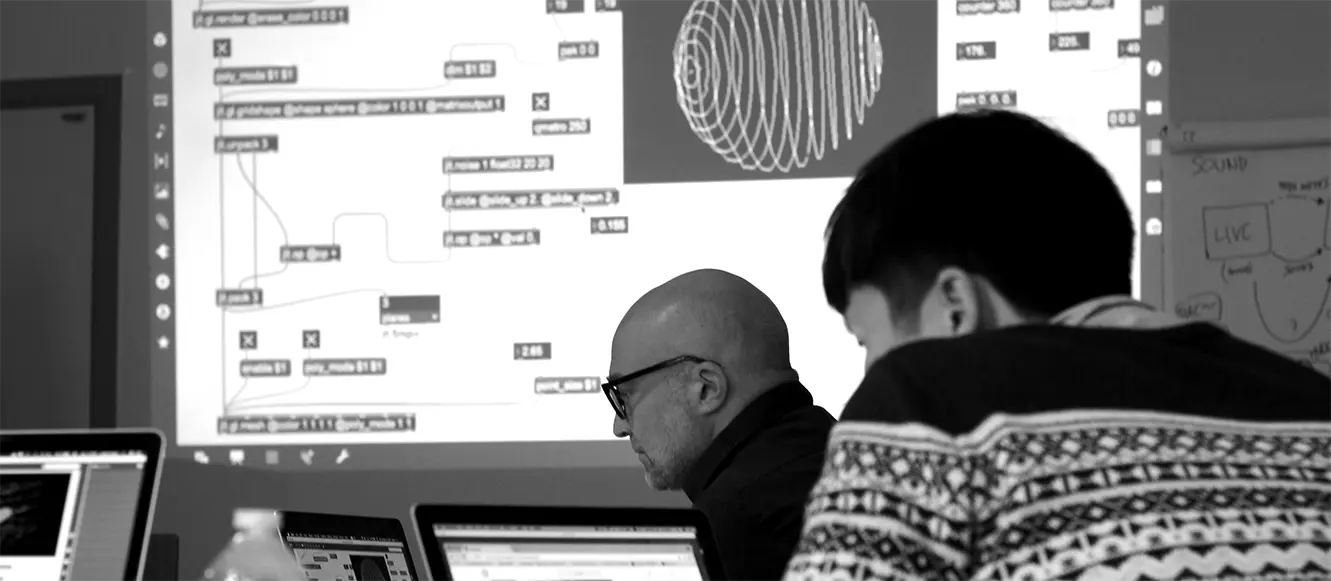
A workshop focused on Max, the visual programming environment for sound, image, and real-time interaction. A common Max/MSP foundation, extended by Jitter (image and video) or Max for Live (creation within Ableton Live). With Julien Bayle, artist, Ableton and Max Certified Trainer, and research engineer (CNRS, Marseille).
Max, formerly known as Max/MSP/Jitter, is a visual programming environment that allows users to manipulate and connect sound, images, motion capture, and data within a single program, called a patch. You can program without writing a single line of code: you connect objects, route signals, and shape behavior in real time.
Its history is directly linked to music research. Max was born at IRCAM in Paris, designed by Miller Puckette in the mid-1980s, and named in honor of Max Mathews, a pioneer of computer music. Since then, it has been developed by Cycling'74 and expanded to include MSP for audio signal processing, Jitter for video, matrices, and 3D, and Max for Live for integration into Ableton Live. Today, it is a legendary ecosystem, acclaimed by the most adventurous artists, from Autechre to Brian Eno to Björk.
The training starts with the basics and builds, step by step, true independence. It is structured around a core five-day module focused on Max (events, messages) and MSP (sound synthesis and processing), followed by two additional days of your choice, depending on the dates.
Jitter Extension (January 11 and 12): Processing video streams, generating images and 3D graphics, designing audio-responsive visual systems, matrices, textures, and rendering.
Max for Live Workshop (January 13 and 14): Design your own devices, instruments, and audio and MIDI effects that run natively in Ableton Live; control Live from Max using the Live API; and build custom tools for both production and live performance. Julien Bayle is the author of *L'art de Max for Live*, the definitive reference book on the subject, which will be provided in digital format to each participant. The course is structured into knowledge blocks, with each block focusing on a specific objective addressed in three stages: demonstration, discussion, and guided practice. The course also introduces participants to RNBO, gen~, and physical computing.
Objectives:
• Understand the graphical programming environment
• Audio signal synthesis and processing with MSP
• Design of interfaces and communication protocols (MIDI, OSC)
• Injecting data to generate sounds and images
• Depending on the chosen specialization: video synthesis and processing with Jitter, or creating instruments and effects in Ableton Live with Max for Live
• Assessing the feasibility of an audiovisual project, installation, or performance
Areas of application:
Music and sound creation, live performance and the performing arts, art installations, experimental audiovisual media, studio production, sound design, and artistic research and development.
This workshop is designed for artists, musicians, composers, visual artists, researchers, teachers, and professionals in the fields of sound and visual media. It is suitable for all skill levels, from complete beginners to advanced participants. Knowledge of digital audio is a plus, but not a prerequisite.

Mentions
Training offered by Structure Void, a Qualiopi- and Ableton-certified training organization
Certified Training Center, founded and directed by Julien Bayle.
Biography(s)
Julien Bayle
Artist, Ableton & Max Certified Trainer, research engineer (CNRS, Marseille)
Julien Bayle, an artist and programmer, works with sound, image, and code as a single medium. As the founder and instructor at Structure Void, he is an Ableton Certified Trainer and a Max Certified Trainer (Cycling’74)—the only instructor in France certified by both organizations. In 2025, he published *The Art of Max for Live*, the only book dedicated to Max for Live (300 pages), following a book on Arduino. His practice spans installations, performances, and generative systems.
Location
13003
Marseille
GMEM (Educational studio)
41 Jobin Street13003
Marseille
Max, Jitter, and Max for Live Training
Julien Bayle
Training
Mon., Jan. 4 —— Fri., Jan. 8, 2027
GMEM (Educational Studio)
Mon., Jan. 11 + Tue., Jan. 12, 2027
GMEM (Educational Studio)
Wed., Jan. 13 + Thu., Jan. 14, 2027
GMEM (Educational Studio)
DURATION
: Seven days (5-day core course + 2-day extension)
9:00 a.m. — 1:00 p.m. and 2:00 p.m. — 6:00 p.m.
Target audience: adults; prior musical and technical experience required.
Equipment: Bring your own computer
Limited space available; registration is now open (costs may be covered by OPCO or AFDAS)
Registration and Contact
https://structure-void.com/contact-fr/
Useful links