 Customize the display
Adjust the colors to ensure sufficient contrast.

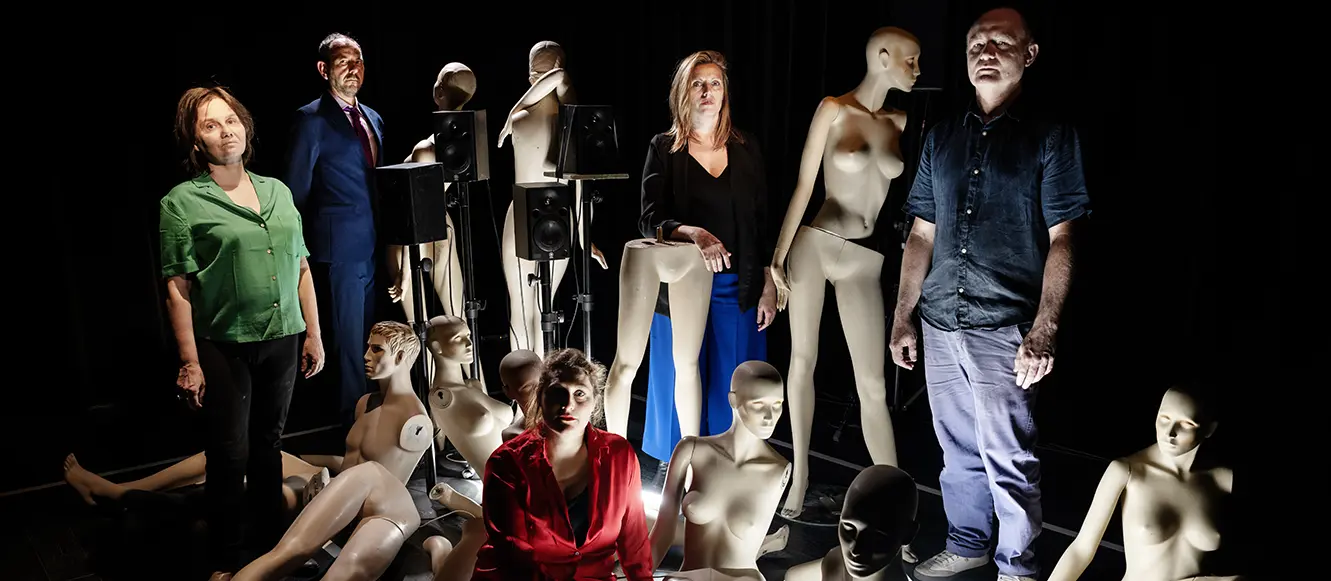
Made using audio and visual archives, *Tomber Sans Bruit* isloosely basedon the industrial and social crisis at Vivarte, a major French conglomerate and leader in the apparel industry.
On stage, employees and executives interact with a chorus of loudspeakers and reenact the echoes of a foretold downfall, blending their voices with electronic music and the trombone.
This lyrical form seeks to bring together the spoken voice, the singing voice, the words it conveys, and the emotions it evokes, in order to open up a shared experience for the audience.
"Between 2001 and 2021, the collapse of the Vivarte group, which had been bought out by vulture funds, was striking but did not make much of a splash. The clothing empire 'fell without a sound'."
Millions of euros remain unpaid, the brands (André, Kookaï, etc.) have been sold off piece by piece, stores have been listed on Le Bon Coin, and employees have been laid off. The unions did their best, according to several executives, some of whom were disillusioned, others cynical. The international investors, who cannot be reached, are trying to keep a low profile.
One of the merits of Élise Dabrowski’s opera is that it pieces together this narrative, scattered across space and time, and imbues it with dramatic power. Drawing on all manner of audiovisual archives (news broadcasts, the *Envoyé spécial* program, recruitment advertisements, testimonies from union members, and more), the singer and musician has crafted a series of vignettes that are eloquent, delightful, biting, sarcastic, burlesque, and ultimately poignant, arranged in the style of a Greek tragedy.
On stage, Élise Dabrowski brings together a cast of performers (...), combining the virtuosity of opera singing with trombone and electronic music, and the direct, whimsical expressiveness of theater. Her aesthetic of collage and juxtaposition brings together very different destinies while painting a collective portrait of a disaster. A keen sense of timeliness and synthesis, put to work in the service of a delightful new kind of political opera."
Cornouaille Theater



Mentions
Created
on December 17, 2024, at POP – an artistic and civic incubator
Production
TREPAK
Support and residency program
Théâtre de Vanves / State-subsidized theater of national interest “Art and Creation” for dance and contemporary writing across the arts
This project received the“
” creation grantfrom the Val-de-Marne department, as well as support from the Fonds de Création Lyrique-SACD, a grant for the creation of a musical performance from SPEDIDAM, a grant for distribution from Adami, and a grant for creation, production, and distribution from the Centre National de la Musique; from Onda—the National Office for Artistic Distribution; from the Maison de la Musique Contemporaine (MMC); and from the Caisse des Dépôts as part of their Legato program
Acknowledgments for the donation of the mannequins
, Dior Museum in Granville
Co-production:
, DRAC Île-de-France (2-year agreement); Adami; La Muse en Circuit (CNCM — Alfortville); Césaré (CNCM — Reims); Théâtre de Cornouaille, National Theater of Quimper; Abbaye de Noirlac; La POP (Paris); Théâtre de Vanves; Issoudun Cultural Center; Val-de-Marne Department; SACD Opera Creation Fund; DGCA-SACEM Program



Biography(s)
Élise Dabrowski
opera singer, double bassist, improviser, and composer
Elise Dabrowski is an opera singer, double bassist, improviser, and composer. It was during her early years at the Maîtrise de Radio France that she developed her passion for contemporary music. Since then, she has devoted herself to contemporary stage works, including pieces by Samuel Sighicelli (Chant d’hiver), Michaël Lévinas (La Métamorphose, at Musica) with the Ensemble du Balcon, Fernando Fiszbein (Avenida de los Incas 3815, Lille Opera), Wolfgang Rihm (Jacob Lenz at theThéâtre de l’Athénée Louis Jouvet), and Alexandre Levy (Fauves at Next Opera Day).
She sometimes combines her two instruments (voice and double bass) in innovative projects and is active on the jazz and improvised music scene, both as a soloist and alongside artists such as Louis Sclavis, Joëlle Léandre, and Fidel Fourneyron. She performs in a duo with Sébastien Béranger on electronics. She founded her company TREPAK to create her own lyrical works with Eric Broitmann on electronics: *Comment s’en sortir sans sortir* with Claudine Simon in 2018, *Pain Maudit* in2019, *Choir* in 2022, and *Tomber Sans Bruit* in2024 at La Pop in Paris, where she is an associate composer through 2026.
Location
13003
Marseille
Friche la Belle de Mai (Petit Plateau)
41 Jobin Street13003
Marseille
To fall silently
Élise Dabrowski, Éric Broitmann
Modulation
Concert
Tue, December 15, 2026 | 7:00 p.m.
Friche la Belle de Mai (Small Stage)
Duration
approx. 1h00
Prices per concert
Full price: 8€
Reduced price: 6€*
*Youth ages 12–25, students, job seekers, recipients of minimum social benefits, freelance workers, seniors aged 65 and older — proof required.
Free admission for Modulations loyalty cardholders (by reservation only)
Practical information
Latecomers will not be admitted to the venue; for certain performances—at the request of the artistic teams—no latecomers will be admitted.
Ticket office
Online: gmem-cncm.mapado.com
By email:billetterie@gmem.org
As part of the Modulations
What are the Modulations?
These are concerts, performances, and regular events…
In other words, a season organized by the GMEM.
Dates for the first semester:
09/15/26— 10/20 — 11/17 — 12/13 — 12/15

Distribution
Élise Dabrowski
composition
Éric Broitmann
composition and live electronics
Christiane Bopp
, co-composition
Jean-Benoît Nison, directed by
Camille Merckx and Aurore Bouston
, recorded vocals
Anaïs Georgel
, sound
Gildas Goujet
light
Franck Jamin
scenography
Angèle Chemin
the employee
Vincent Vantyghem
the CEOs, one voice
Élise Dabrowski
the leader
Christiane Bopp
the trombonist and an employee
Eric Broitmann
an employee
Formeremployees and executives of the Vivarte Group: Antoine Veyronnet, Élise Dabrowski, Sophocle
, texts
Useful links