 Customize the display
Adjust the colors to ensure sufficient contrast.


A century and a half of artistic exchange between Marseille and the United States (1875–2026)
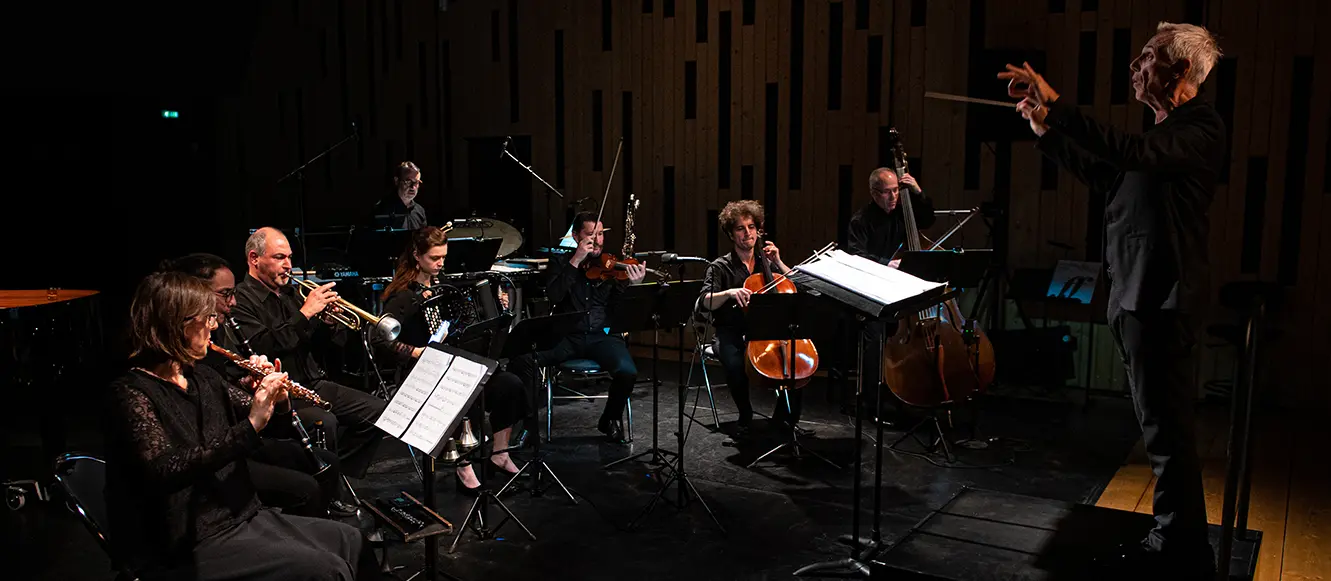
In 2018, the Ensemble Télémaque launched October Lab, an international platform dedicated to musical creation, whose mission is to produce and present new works that bridge different styles and aesthetics. Through commissions awarded to composers from around the world, it explores ever-evolving themes.
"Sounds, Tears and Skins " marks the Télémaque Ensemble’s first collaboration with American artists. Under the direction of Raoul Lay, the ensemble is commissioning works this year from a new generation of composers: Yu-Hui Chang, John Aylward, and Kate Soper, along with doctoral students in composition met at Brandeis University. Their compositions are based on French and American texts—either written with particular significance or having left a lasting impact in Marseille and the United States.
The project brings together five major figures of modern literature: Mary Jane Gold (Crossroads Marseilles, 1940), Franz Werfel, Antonin Artaud, Marcel Proust, and Arthur Rimbaud. All of them, to varying degrees, have faced discrimination because of their gender, and/or their background, and/or their differences (ethnic or religious identity, political beliefs, sexual orientation, mental health conditions, etc.).
Spanning history—before, during, and after World War II—the project explores the concepts of travel, migration, and the history of minorities along a Marseille-to-United States axis. How do contemporary artists engage with these fractured moments in history, whose resemblance to the present raises questions?
The concert consists of five pieces in which spoken and sung voices interact with the instrumental music, using intertextuality as a sensitive means of expressing diversity.


Mentions
Supported by
Institut français - Villa Albertine; Centre National de la Musique; Spedidam; Adami
Around the show
Thu., September 17 | 7:15 p.m. | Fondation Camargo (Cassis)
CONCERT & MEET-AND-GREET
Artaud, Gold, and Werfel: The American Invitation
To kick things off, a discussion with artists Kate Soper, Yu-Hui Chang, and John Aylward.
Sun., September 20, 2026 | 3:30 p.m. |PIC
COMMENTED CONCERT
Inside STS: An American Journey
Live analysis by Raoul Lay and the musicians of Télémaque of the works from the *Sounds, Tears and Skins* program
Biography(s)
John Aylward
compositeur
Compositeur et pianiste, John Aylward a grandi dans le désert de Sonora, à la frontière entre l’Arizona et le Mexique, enfant d’une mère immigrée d’Allemagne (elle-même réfugiée de la Seconde Guerre mondiale), dans des circonstances extrêmement instables. Sa musique reflète les riches expressions des histoires culturelles convergentes et les communautés profondément entremêlées de cette vie antérieure, le tout dans les paysages surnaturels du désert. Après des études initiales de piano et de composition avec Nicholas Zumbro et Pamela Decker, John a étudié la composition musicale en Nouvelle-Angleterre avec Martin Boykan et David Rakowski, et a écrit une thèse sur le 5e quatuor à cordes d’Elliott Carter avec le musicologue Eric Chafe et le soutien de deux bourses d’études résidentielles de la Paul Sacher Stiftung à Bâle, en Suisse. Les prix et bourses d’Aylward ont récemment été décernés par la Fondation John S. Guggenheim, l’American Academy of Arts and Letters, le Radcliffe Institute de l’université Harvard, la Commission Koussevitzky du Congrès, la Fromm Foundation, MacDo-well, Tanglewood, l’Atlantic Center for the Arts, le Virginia Center for the Creative Arts.
Yu-Hui Chang
compositrice
La compositrice multirécompensée Yu-Hui Chang crée un grand nombre d’œuvres qui résonnent profondément avec les musiciens et le public, par son énergie, sa précision, ses effets inventifs et ses couleurs vibrantes. Son travail transcende les frontières culturelles et stylistiques, embrassant la diversité musicale et la fluidité. Yu-Hui a reçu de nombreux prix, dont le Arts and Letters Award, la bourse Charles Ives, la bourse Guggenheim Foundation et des commandes d’institutions aussi prestigieuses que la Fromm Music Foundation et la Koussevitzky Music Foundation. Ses compositions de chambre et orchestrales ont été interprétées dans de nombreux pays, dont les Pays-Bas, l’Italie, le Japon et les États-Unis, avec des éloges critiques unanimes. Originaire de Taïwan, elle enseigne à la faculté de composition de l’Université Brandeis depuis 2006. Ses œuvres ont été présentées dans de grands festivals de musique contemporaine à travers le monde. Elle a également été co-directrice artistique de l’Empyrean Ensemble et du Dinosaur Annex Music Ensemble, où elle a organisé plus de soixante-dix concerts. En janvier 2024, son CD portrait "Mind Like Water" est sorti.
Jingmian Gong
compositrice
Jingmian Gong est une compositrice dont les œuvres ont été interprétées par des ensembles de renom tels que l’Ensemble Dal Niente, le Lydian String Quartet, Lamnth et Hub New Music. Sa dernière création a été présentée par l’Ensemble Télémaque. Parmi ses commandes récentes figurent des œuvres pour Collage New Music, ainsi que des collaborations avec plusieurs interprètes et ensembles de la scène musicale de Boston. Membre du corps enseignant du Berklee College of Music, Jingmian poursuit actuellement un doctorat en composition et théorie musicale à l’université de Brandeis. Elle est titulaire d'un Bachelor of Music du Boston Conservatory at Berklee et d'un Master of Fine Arts de Brandeis.
Dylan Needleman
compositeur
Dylan Needleman est compositeur, producteur et programmeur, originaire du nord du New Jersey. Il prépare actuellement un Doctorat en composition musicale à l'Université de Boston, et est titulaire d'un Master of Fine Arts en composition et théorie musicale de l'Université Brandeis. Son travail de composition traverse de nombreux genres, mêlant des influences aussi diverses que le Hardcore Punk, le Minimalisme américain et le Harsh Noise. Ses œuvres ont été interprétées par le Lydian String Quartet, le duo LAMNTH, le TALEA Ensemble, et bien d'autres.
Kate Soper
compositrice
Kate Soper est codirectrice et interprète de Wet Ink, un groupe new-yorkais dédié à la recherche d’une musique aventureuse au-delà des frontières esthétiques. Elle est la professeure de musique au Smith Collège. Décrite par The New Yorker comme "l’une des personnalités les plus originales de sa génération", la compositrice/interprète/écrivaine Kate Soper a créé des spectacles de théâtre musical d’une inspiration forte et singulière pendant plus d’une décennie. Finaliste du prix Pulitzer et boursière du prix de Rome, elle a reçu des prix et des bourses des fondations Guggenheim et Koussevitzky et de l’American Academy of Letters, et a reçu des commandes du Miller Theatre, d’Alarm Will Sound et du New York Philharmonic. Ses œuvres comprennent les monodrames « Voices from the Killing Jar » et « IPSA DIXIT », ainsi que les opéras « Here Be Sirens », « The Romance of the Rose » et « The Hunt ». Félicitée par le New York Times pour sa "voix souple et sa présence captivante", Soper se produit fréquemment en tant que soprano spécialisée en musique contemporaine.
Location
13003
Marseille
Friche la Belle de Mai (Petit Plateau)
41 Jobin Street13003
Marseille
October Lab #7: Sounds, Tears, and Skins
The Telemachus Ensemble
Modulation
Concert
Tue, September 15, 2026 | 7:00 p.m.
Friche la Belle de Mai (Small Stage)
Duration
approx. 1h10
Prices per concert
Full price: 8€
Reduced price: 6€*
*Youth ages 12–25, students, job seekers, recipients of minimum social benefits, freelance workers, seniors aged 65 and older — proof required.
Free admission for Modulations loyalty cardholders (by reservation only)
Practical information
Latecomers will not be admitted to the venue; for certain performances—at the request of the artistic teams—no latecomers will be admitted.
Ticket office
Online: gmem-cncm.mapado.com
By email:billetterie@gmem.org
As part of the Modulations
What are the Modulations?
These are concerts, performances, and regular events…
In other words, a season organized by the GMEM.
Dates for the first semester:
09/15/26— 10/20 — 11/17 — 12/13 — 12/15

Distribution
The "
" Telemachus Set includes
Raoul Lay
conductor
Charlotte Campana
flute
Linda Amrani
clarinet
Gérard Occello
trumpet
Damien Paradisi
accordion
Christian Bini
percussion
Yann Leroux-Sèdes
violin
Jean-Florent Gabriel
cello
Brigitte Peyré
soprano
Agnès Audiffren
actress
actress
Program
Proust Impression
de Jingmian Gong
< CRÉATION > par l’Ensemble Télémaque dans le cadre du programme doctoral de l’université de Brandeis
Antonin Artaud’s Drama of the Mind
de Kate Soper
< CRÉATION > commissionnée par l’Ensemble Télémaque, direction Raoul Lay
Les Ponts
de Dylan Needleman
< CRÉATION > par l’Ensemble Télémaque dans le cadre du programme doctoral de l’université de Brandeis
Between heaven and earth
de John Aylward
< CRÉATION > commissionnée par l’Ensemble Télémaque, direction Raoul Lay
Accidental Hero
A mini music drama
de Yu-Hui Chang
< CRÉATION > commissionnée par l’Ensemble Télémaque, direction Raoul Lay
Useful links