 Customize the display
Adjust the colors to ensure sufficient contrast.

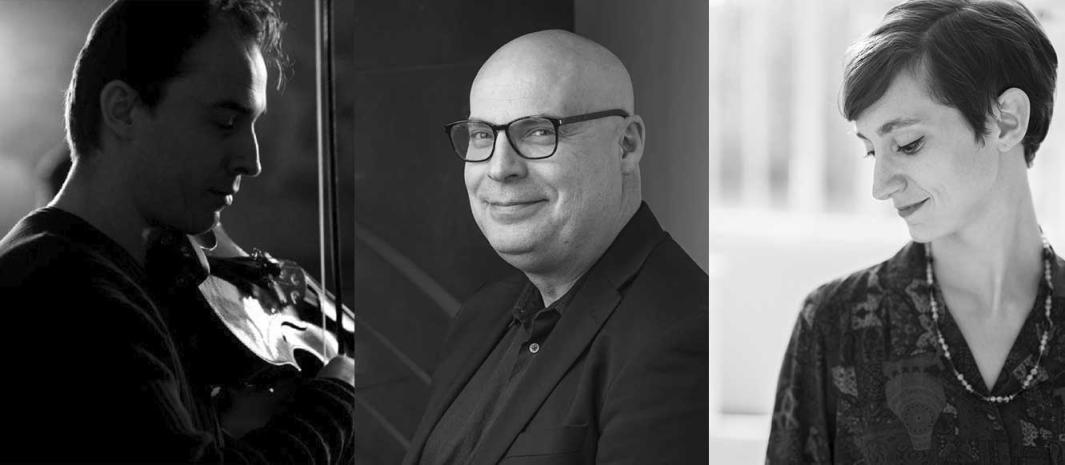

This concert marks the debut of Parophone, an original trio featuring mezzo-soprano, alto and bass clarinet. Three voices, three timbres, three breaths that come together like the syllables of a rare word - Parophone: like those words we pronounce "almost the same", whose proximity invites us to play with sound and meaning.
At the heart of the program are three pieces for trio by Roger Tessier(Éclats de soleil), François Bousch(Murmures Éblouis) and Alain Louvier, whose trio will have the pleasure of premiering Phonèmes, a piece written especially for their group.
Around these works, a constellation of duets and solos will reveal the nuances and possibilities of this "three-headed machine" - between sound poetry, timbral theater and language games.
A concert that's poetic, playful and sometimes humorous, where instruments become voices, and voices become instruments.
Mentions
Co-produced by
Ville de Marseille - Opéra
Biography(s)
Laura Muller
mezzo-soprano
After training as a choir member in Le Puy-en-Velay and pursuing literary studies through the master’s level, Laura Muller studied opera singing in Paris, where she earned a DEM in 2018. She also attended Françoise Tillard’s Lied and melody class, and during this time participated in masterclasses led by Regina Werner and Donna Brown. She was a laureate of the Académie des Paris Frivoles in 2019. She performs regularly with vocal ensembles such as Les Métaboles (conducted by Léo Warynski) and Sequenza 9.3 (conducted by Catherine Simonpietri). She is regularly invited as solo alto by the Paris Chamber Music Center (conducted by Jérôme Pernoo) for the “Bach and Breakfast” cantata series. In 2022, she performed the solo alto part in Bach’s St. John Passion with the Concert d’Astrée and the Hemiolia ensemble. She regularly participates in productions and concerts with the Parole et Musique association (artistic director Françoise Tillard). There, she has notably sung the role of Gontran in Chabrier’s Une Éducation manquée ! and the role of Mazet in Gounod’s La Colombe. In recent years, Laura has been particularly involved in the contemporary repertoire. As a soloist, she has participated in numerous premieres, including: *Pion prend tour en D9*, an opera by Bruno Giner (conducted by Philippe Nahon); *Dorian Gray, a quest for eternal youth*, an opera by Mariana Ungureanu (conducted by Ajtony Csaba); *Cinq études sacrées* by Yann Robin (conducted by Léo Warynski, France Musique); The Sixth Commandment by Elżbieta Sikora (Szczecin Philharmonic, Poland); Lacrimosa, for mezzo-soprano and instrumental ensemble by Lorenzo Troiani (Festival Ensemble(s), Paris 2023). Franck Bedrossian’s piece for a cappella mezzo-soprano, Départs de feu, was written for her voice and is dedicated to her. This piece premiered on Anne Montaron’s program Création mondiale on France Musique, then in public at the Zagreb Contemporary Music Biennale (April 2023). In June 2023, she performed this piece along with Philippe Leroux’s Ma Belle si tu voulais (solo voice a cappella) at the Marseille Opera House as part of the GMEM’s Propagations festival. In 2024, she premiered Visions by Matteo Franceschini and a piece by Pasquale Corrado at the Milano Musica festival. She is also preparing a recital program featuring American art songs (Ives, Barber, Copland) alongside tenor Stuart Patterson and pianist Irina Kataeva.
Laurent Camatte
viola
A graduate of the Paris Conservatory (CNSM) with degrees in viola and music analysis, Laurent Camatte quickly established himself as a leading performer in the contemporary music scene, whether with ensembles such as InterContemporain—with whom he performed, among other works, Pierre Boulez’s *Eclat-Multiples* under the composer’s baton—or with the Ensemble Court-circuit, 2e2m, Accroche-notes, 2e2m, and the Pelleas Chamber Orchestra, of which he is a founding member. His extensive repertoire has taken him to stages around the world as both a soloist and a chamber musician, collaborating with partners such as Michael Levinas, Nicolas Angelich, the Voce Quartet, and Wilhelm Latchoumia. Sir Simon Rattle invited him to the Berlin Philharmonie in May 2015 for the German premiere of Betsy Jolas’s *Ruht Wohl*. Laurent Camatte is the principal viola of several ensembles: Court-Circuit (since 2015), Proton Bern (2013), and Multilatérale (2005). His dual role as violist and analyst is of particular interest to composers with whom he has developed close collaborations: Betsy Jolas—whose works he premiered, including Ruht Wohl (dedicated to him), Well met, Sur Do, and Femme en son jardin—György Kurtág (Hommage à Schumann), Pascal Dusapin (Inside), Martin Matalon (Traces II for viola and electronics), Michael Lévinas (Lettres enlacées for solo viola), Philippe Schoeller (Visions de Nefertiti I and II)… Several composers wrote works for him: Betsy Jolas, Michael Lévinas, Samuel Andreyev, Gilles Schuehmacher, Frédérik Martin (viola concerto), Alberto Caprioli (whose viola concerto he premiered), Robert Coinel (concerto), and Jacques Lenot, who has dedicated five works to him: November Elegy, for solo viola and string orchestra; Répliques for solo viola; Erinnern als Abwesenheit III for viola and large ensemble; Abrupts jeux d’ailes for viola and string orchestra; Néfertiti auprès et au loin… for solo viola. He is also the recipient of the Prince Louis de Polignac Foundation Board of Directors Award (2016), the Edmund Pendleton International Prize (2003), as well as the Jean Françaix (1998) and Epernay (1996) international viola competitions.
Among his major recordings, which have been honored with, among other awards, two Grand Prix from the Académie Charles Cros in 2011 and 2012, are “Moving” by Samuel Andreyev (Klarthe 2016); “B for Betsy” (works for viola by Betsy Jolas – Hortus 2012); “Chiaroscuro” (Erinnern als Abwesenheit III by Jacques Lenot – Intrada 2011); “Vulcano” by Yann Robin (Ensemble Intercontemporain, S. Mälki, Kairos 2010); “String Trio” and “Clarinet Quintet” by Betsy Jolas (Accord 2006); “Troisième Round” and “Turbulences” by Bruno Mantovani (Aeon 2003).
Alain Billard
bass clarinet
A graduate of the Conservatoire Supérieur de Musique et de Danse de Lyon with a DESM degree, Alain Billard has been a member of the Ensemble intercontemporain since 1995. He serves as the bass clarinetist (also playing clarinet, basset horn, and contrabass clarinet). An internationally renowned soloist, he has collaborated with numerous composers from the 20th century to the present day, including Pierre Boulez, Luciano Berio, György Ligeti, Karlheinz Stockhausen, as well as Philippe Manoury, Michael Jarrell, Pascal Dusapin, Bruno Mantovani, and Yann Robin. Regularly invited as a soloist by major national and international orchestras, he has premiered and recorded numerous works, including Lisa Lim’s *Machine for Contacting the Dead* (2001), Jean-Louis Agobet’s *Génération* (2002), a triple concerto for three clarinets, Bruno Mantovani’s *Mit Ausdruck* (2003), a concerto for bass clarinet and orchestra, Décombres by Raphael Cendo (2007), Art of Metal I, II, III (2007–2008) for contrabass clarinet, ensemble, and electronics by Yann Robin, Del reflejo de la sombra (2010) by Alberto Posadas with the Diotima Quartet, and La Grammatica del soffio (2011) by Matteo Franceschini. A founding member of the Nocturne Wind Quintet, with which he won First Prize in Chamber Music at the Lyon Conservatory, Second Prize at the ARD International Music Competition in Munich, and the Osaka Chamber Music Prize (Japan), he founded the Trio Modulations alongside Odile Auboin (viola) and Hidéki Nagano (piano), to which composers Marco Stroppa, Bruno Mantovani, and Philippe Schoeller have already dedicated new works. Alain Billard is very active in the field of research and development of new instrumental techniques. He collaborates regularly with IRCAM and the Selmer company. His active participation in the Ensemble’s educational initiatives, aimed at young audiences and future music professionals, attests to his deep commitment to the transmission of music in all its forms.
Roger Tessier
Composer
Roger Tessier was born on January 14, 1939, in Nantes. He studied music at the Conservatory in his hometown before entering the Paris Conservatory in 1959, where he studied analysis with Olivier Messiaen, harmony with Henri Challan, fugue with Alain Weber, and orchestral conducting with Eugène Bigot. He then devoted himself to composition and teaching. In 1972–1973, Roger Tessier was a founding member of the contemporary music ensemble L'Itinéraire.
He won the Sacem Stéphane-Chapelier Prize in 1978, received the Fondation de France award in 1980, and that same year became responsible for organizing contemporary music concerts in the Versailles Academy.
In 1981, he received the Grand Prix from the Académie du disque français Charles Cros and was appointed secretary general of the French section of the International Society for Contemporary Music, an institution where he served on the executive board from 1987 to 1990 and as treasurer in 1982.
In 1982, Roger Tessier became the founding director of the Angers Festival of 20th-Century Music. He participated in the Darmstadt Festival in 1984, became director of the Angers Conservatory in 1987, and from 1991 served as director of the Conservatory of Paris’s 14th arrondissement, where he established a composition class.
The Academy of Fine Arts awarded him the Jacques-Durand Prize in 1990 and the Florent-Schmitt Prize in 1991.
François Bousch
Composer
François Bousch, born on July 24, 1946, in Paris, pursued his musical studies at the Schola Cantorum (History of Music) and at the Paris Conservatoire (Composition, Analysis, Ondes Martenot, Orchestral Conducting, Composition) under the guidance of Michel Guiomar, Charles Bruck, Jeanne Loriod, Jean-Pierre Guézec, Betsy Jolas, Claude Ballif, and Olivier Messiaen. During his studies, he met Luciano Berio and Karlhein Stockhausen. In 1972, he received the Roger Ducasse Prize. In 1974, appointed a Resident of the French Academy in Rome (Grand Prix de Rome) for two years, he stayed at the Villa Medici. He met artists from all over the world, including Michiko Hirayama, James Dashow, and Luca Pfaff, and forged a fruitful relationship with the Italian composer Giacinto Scelsi. His work for large orchestra, *Souffle de Vie-Lumière*, was noted by Italian Radio.
Starting in 1974, he actively participated in the Itinéraire ensemble’s endeavors alongside Tristan Murail, Roger Tessier, Pierre-Yves Artaud, and others, as well as on its Programming Committee (1978–1981). In 1977, Tristan Murail invited him to join the Itinéraire Electronic Instruments Ensemble. He gave numerous concerts, premiered many works, and participated in numerous recordings (electric guitar and electronic keyboards) with this ensemble, the Ensemble Intercontemporain, the Ensemble 2E2M, the Ensemble Ars Nova, and the orchestras of Radio France and Sicily… In 1980, he was an intern at IRCAM with Tristan Murail, Gérard Grisey, Pascal Dusapin, Hugues Dufourt, Michaël Lévinas, and Roger Tessier. In 1981, Sacem awarded him the Georges Enesco Prize. In 1982, the Music Directorate of the Ministry of Culture entrusted him with the task of establishing the Ensemble Instrumental de Basse-Normandie, serving as its artistic and musical director. In 1988, he completed an internship at the GRM (Groupe de Recherches Musicales of the Institut National de l’Audiovisuel) under the guidance of Daniel Teruggi, alongside Philippe Leroux. In 1990, he was awarded the title of Chevalier des Arts et des Lettres by the Minister of Culture. That same year, he founded the ensemble Sine Qua Non, serving as its artistic director and later as its honorary president. From 1992 to 1996, he was appointed Vice President of the Symphonic Music Commission of Sacem. From 1996 to 2001, he served as president of the French section of the International Society for Contemporary Music, an international association founded in 1922 in Salzburg, bringing together prestigious names such as Ravel, Bartók, Webern, Hindemith, Kodály, Berg, Roussel, Schoenberg, Koechlin, Milhaud, Poulenc, and Dutilleux… Today, it includes 50 countries around the world, including France. Its headquarters are located at UNESCO in Paris.
Alain Louvier
Composer
Born in 1945, Alain Louvier pursued studies in mathematics while winning nine first prizes at the Paris Conservatory, where he studied under Olivier Messiaen and Manuel Rosenthal, among others. In 1968, he was the last winner (based on written exams) of the “First Grand Prix de Rome for Musical Composition” awarded by the Institut de France. A resident at the Académie de France in Rome from 1969 to 1972, he subsequently received other honors, including the Honegger Prize (1975), the Paul Gilson Prize (1981), and the Georges Enesco Prize from SACEM (1986). As director of the CNR in Boulogne-Billancourt from 1972 to 1986, he implemented a notable educational reform, notably by commissioning short pieces for students—including those at the beginner level—from some fifty very diverse composers. As director of the Paris CNSM from 1986 to 1991, he oversaw the Conservatory’s move to the Cité de la Musique in 1990, while laying the groundwork for new departments: Pedagogy, Sound Engineering, Contemporary Dance… From 1991 to 2009, Alain Louvier taught musical analysis at the CNSMDP and orchestration at the CNR in Paris. In May 2009, he took over as director of the Conservatoire à Rayonnement Régional de Boulogne-Billancourt. Since 1971, he has been active as a conductor focused on premiering numerous new works, particularly with the Ensemble de l’Itinéraire, or within the framework of conservatories (Stockhausen, Scelsi, Grisey, Lévinas, Tessier, Stroë, Murail, Blondeau, Campana, Mantovani, Campo…). In his work as a composer, Alain Louvier has, since 1964, offered a highly personal style of writing and gestural language for keyboard instruments (Études pour Agresseurs, Agrexandrins); He is also interested in the musical translation of geometric curves or numerical sequences (Hommage à Gauss, 9 Carrés pour 4 flûtes, Chant des Aires, l’Isola dei Numeri); He also opened up new horizons by introducing modality into the microtonal world of quarter-tones (Le Clavecin non Tempéré, Suite en Do, Anneaux de Lumière, “S”).
Yann Robin
Composer
Yann Robin, a French composer, began his musical studies in Aix-en-Provence. In 1994, he entered the jazz program at the CNR in Marseille, where he was awarded First Prize. At the same time, he joined Georges Bœuf’s composition class, where he received a unanimous First Prize, along with an award from Sacem. He continued his studies in Harmony and Counterpoint at the CNR in Paris and pursued Musicology at the Sorbonne. In 2003, he entered the Conservatoire National Supérieur de Paris, studying composition with Frédéric Durieux as well as in Michaël Levinas’s class, where he earned his prize in music analysis. In July 2004, he participated in Jonathan Harvey’s composition course at the Acanthes Center and resided at the Royaumont Foundation, where he worked with Brian Ferneyhough, Michaël Levinas, and Jean-Luc Hervé. In 2006, he was selected for the 4th Forum of the Ensemble Aleph. That same year, he received a fellowship from the Meyer Foundation. From 2006 to 2008, he completed the two-year computer science program at IRCAM. In 2003, he received a state commission from the Ministry of Culture and wrote *Les Couleurs du Temps* for the National Youth Wind Orchestra. The following year, he won first prize at the Frédéric Mompou International Composition Competition in Barcelona with *Styx*, as well as a Franco-Chilean competition that took him to Santiago, Chile, where the Antara ensemble premiered *Litaneia*. That same year, the Ensemble Intercontemporain premiered his *Quatuor Phigures*. In 2005, he was in residence at La Muse en Circuit, where he composed Chaostika for a percussionist and a 5.1 electronic setup. Following a commission from Sacem for UNESCO’s 60th anniversary, Polycosm was premiered for five traditional instruments and orchestra. For the 2006–2007 season, ARCAL commissioned him to create a musical theater project inspired by Goethe’s novel *Wilhelm Meister’s Apprenticeship*, which premiered on December 16 of that year. On January 28, 2007, the Ensemble Orchestral Contemporain, conducted by Dominique My, premiered his concerto for contrabass clarinet,*Art of Metal*, written for Alain Billard, soloist with the Ensemble Intercontemporain. This concerto inaugurates a cycle of three pieces centered on the metal contrabass clarinet. From 2006 to 2008, he served as composer-in-residence with the Orchestre National de Lille. His music is performed both in France and abroad. In 2005, he co-founded the Ensemble Multilatérale with other composers and became its artistic director. His music is published by Editions Jobert.
Henri Pousseur
Composer
Henri Pousseur (1929–2009), a leading Belgian avant-garde composer, grew up during the turbulent years of World War II, influenced by both Belgian and German traditions. Trained at the Conservatory of Liège, he was quickly influenced by dodecaphonism and the music of Schoenberg, Webern, and Boulez, whom he met in the early 1950s. He thus became part of the post-Webernian movement, while developing an early interest in electronic and experimental music.
In the 1950s, he collaborated with figures such as Stockhausen and Berio and produced several pioneering works, blending instruments, electronic sounds, and aleatoric techniques. His work also explores the interactions between musicians, viewed as social models. Starting in the 1960s, he expanded his musical language by reintegrating harmony and consonance into a renewed serial approach, notably in *Votre Faust*, an emblematic work conceived with Michel Butor.
Subsequently, Pousseur developed a compositional style based on the transformation of musical materials and the dialogue between styles, revisiting musical history from Monteverdi to Schoenberg. At the same time, he pursued a career as an influential teacher and educator, helping to modernize music education in Liège. Weakened by illness toward the end of his life, he passed away in 2009, leaving behind a rich body of work at the intersection of theoretical research, sound experimentation, and reflection on the social role of music.
Evan Ziporyn
Composer
Composer, conductor, and clarinetist, Evan Ziporyn creates music at the crossroads of cultures, drawing inspiration from Balinese music and the international contemporary music scene. He has collaborated with many leading artists, including Yo-Yo Ma, Maya Beiser, Terry Riley, and Bang on a Can, and his arrangements have been featured inKen Burns’ *The Vietnam War*.
Among his recent projects is an orchestral reinterpretation ofBlackstar, David Bowie’s final album, which he has been conducting with his Ambient Orchestra since 2017 on numerous international stages. His catalog also includes works blending Western instruments, gamelan, and electronic devices, as well as immersive installations and interdisciplinary collaborations.
Trained in the United States under Joseph Schwantner, Martin Bresnick, and Gérard Grisey, he founded Gamelan Galak Tika in 1993 and established himself as a pioneering figure in the dialogue between musical traditions. From 1992 to 2012, he was a central figure in the Bang on a Can All-Stars ensemble. He also pursues a career as a performer and educator, and currently serves as a professor and director at MIT.
Location
13001
Marseille
Opéra de Marseille (Foyer Ernest Reyer)
2, rue Molière13001
Marseille
The Parophone
Laura Muller, Laurent Camatte, Alain Billard
Modulation
Concert
Sun. May 10, 2026 | 11:00 am
Opéra de Marseille (Foyer Ernest Reyer)
Duration
approx. 1h10
Prices per concert
Full: 8€
Reduced: 6€*
*Young people aged 12-25, students, jobseekers, social security recipients, intermittent workers, senior citizens aged 65 and over - on presentation of proof.
Free admission for Modulations loyalty card holders (by reservation only)
Practical information
Latecomers will not be admitted to the concert hall, as some shows - at the request of the artistic teams - do not tolerate late entry.
Ticketing
Online: gmem-cncm.mapado.com
By e-mail: billetterie@gmem.org
As part of Modulations
What are Modulations?
Concerts, performances, regular events...
In other words, a season organized by the GMEM.
2nd semester dates:
20/01/26- 17/02 - 17/03 - 22/03 - 21/04 - 10/05

Distribution
Laura Muller
mezzo-soprano
Laurent Camatte
viola
Alain Billard
clarinets
Program
Draft III
for solo viola
Yann Robin
Phonèmesfor Cathy
for solo mezzo-soprano
, Henri Pousseur
Phonèmes
for mezzo-soprano, alto, and clarinets
World Premiere
Alain Louvier
Tsmindao Ghmerto
for solo bass clarinet
Evan Zyporin
Sunbeams (2016 — 12 min.)
for mezzo-soprano, alto, and clarinets
Roger Tessier
Murmures Éblouis(2019 — 12 min. 30 sec.)
for mezzo-soprano, viola, and bass clarinet
: François Bousch
Useful links