 Customize the display
Adjust the colors to ensure sufficient contrast.

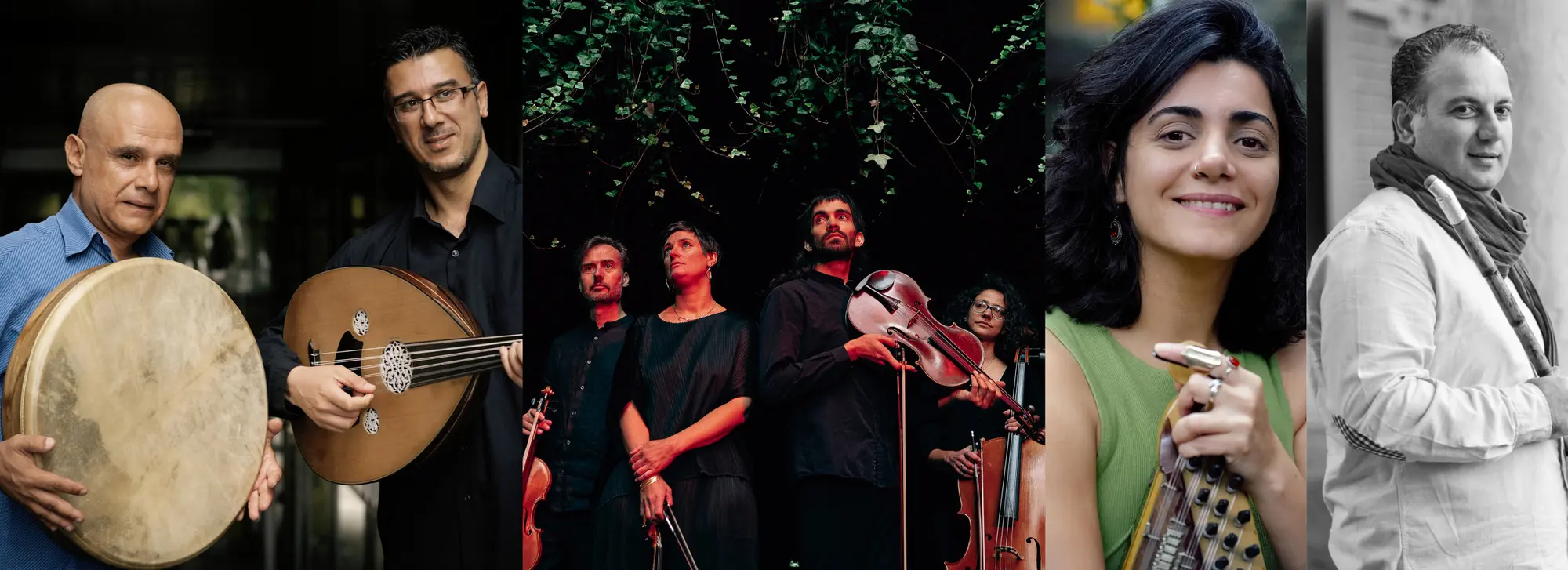
It is a joyful musical adventure, driven by a spirit of sharing and mutual respect. It features a unique collaboration between eight musicians: four Eastern soloists—playing the oud, kanun, nây, and percussion—and a Western string quartet. Two worlds, breathing as one.
In this fertile land, boundaries do not disappear—they shift. The strings vibrate, the sound of the nây rises, and the rhythms shape the music. The music flows, alive and full of energy. It blends the richness of Eastern maqams with the power of Western polyphony, without ever taking sides.
Together withMa_Jara, the Béla Quartet, the Sabîl Duo, Laila Mahmoud, and Moslem Rahal are creating a new space for connection. Something is taking shape right here, right before our ears.
Mentions
Production:
, the Béla Quartet, Association l’Oreille Droite
Co-production
, Espace Culturel de Chaillol—Art en territoire-affiliated theater (Hautes-Alpes); GMEM; Théâtre de St Quentin en Yvelines—Scène Nationale; Cité de la Musique de Marseille—Pôle des Musiques du Monde
Supported by
La Coopérative — Réseau pour la création musicale; DRAC PACA; Spedidam
Biography(s)
Béla Quartet
string quartet
For 19 years, “the enfants terribles of the French string quartet” have been forging a unique path, blending tradition and modernity. Committed to the historic string quartet repertoire, which they champion in premier classical concert series in France and abroad (Philharmonie de Paris, Mariinsky Theater, BeethovenFest...), the musicians of the Béla Quartet are committed to integrating the string quartet tradition into contemporary musical life. Their work on commissions and premieres in collaboration with composers of different generations (Sofia Avramidou, Gavin Bryars, Francesca Verunelli, Misato Mochizuki, Noriko Baba, Kaija Saariaho, Philippe Leroux, Francesco Filidei, Benjamin de la Fuente, Jean-Pierre Drouet, François Sarhan, Daniel D’Adamo, Thierry Blondeau, Marco Stroppa, Jérôme Combier, Garth Knox, Karl Naegelen, Frédéric Aurier, Robert HpPlatz, Aurelio Edler-Copes, Frédéric Pattar...) was recognized in 2015 with the International Music Press Award.
Driven by a sincere conviction and inspired by the personality and work of Béla Bartók, the quartet conceives collaborations with eclectic artists. This is evident in “Si oui, oui. Sinon non” featuring cult rocker Albert Marcœur, “Impressions d’Afrique” with the late griot Moriba Koïta, and “Jadayel” alongside Palestinian masters Ahmad Al Khatib and Youssef Hbeisch...
The Béla Quartet, renowned for its “diabolical technique” (Télérama) and its musical commitment, has in recent years willingly dedicated itself to the works of early 20th-century Central European composers such as Janáček, Schulhoff, Krása, Bartók, Szymanovsky, and Webern...Its discography has been acclaimed by international critics (Télérama, Luister10 Award, Gramophone Critics’ Choice Award, Prix Charles Cros, Diapason, Le Monde...).
Ahmad Al Khatib
oud and composition
A composer and musician, Ahmad Al Khatib has a deep, instinctive mastery of his ancestral musical culture. Already recognized as a leading figure in its continuation, he is driving it toward new directions. Beginning at the age of eight, he studied under the rigorous tutelage of the Palestinian oud master Ahmad Abdel Qasem. He excelled in his studies in musicology and Western classical cello. After several years teaching at the Edward Said National Conservatory of Music in East Jerusalem, he was forced to leave Palestine; he has since published works that are now standard references for oud instruction and musical transcription for Arab composers.
Since 2004, he has been teaching modal music theory, composition, and ensemble performance at the University of Gothenburg. In Sweden, he performs with musicians who draw inspiration from Scandinavian folklore. And while the Middle East rolls out the red carpet for this respected master, the West invites him to so-called “world music” festivals, where he listens with interest to the traditions of many different cultures. This artist, curious about musical languages other than those of his own roots, has thus had ample opportunity to draw inspiration from a wide variety of sources. Even if painful roots then become precious and are embraced all the more. One foot in the past, one foot in the future: the image also fits Ahmad the instrumentalist, a performer whose playing is pure and imbued with depth, who consistently explores every expressive facet of the oud and tirelessly seeks out the most fitting nuances.
Youssef Hbeisch
percussion
Born in Galilee, Youssef Hbeisch taught for many years at the Beit Al Musica Conservatory (Shefa Amr, Galilee), where he led master classes and percussion workshops in art therapy. He now lives in Paris, but his numerous collaborations take him all over the world. He has composed for theater and film and has performed with Karloma, the Oriental Music Ensemble, Simon Shaheen, Süleyman Erguner, Aka Moon, Issa Hassan, Khaled, Lena Chamamyan, Dorsaf Hamdani, Ibrahim Maalouf, Sister Marie Keyrouz, Lo Cor de la Plana and Manu Théron, Rula Safar, Bratsch, Abed Azrié, the Khoury Project, Philippe El Hage... He is also the fourth member of the Joubran Trio. At every concert, audiences are amazed by his dexterity and swept up in the immense joy that radiates from his improvisation.
An instinctive musician, Youssef Hbeisch immediately finds his place in any piece and then leaves his mark on it during the collaborative creative process. This signature style, shaped by his musical discoveries since he was very young, draws on Latin, Indian, African, and Brazilian influences... Youssef has developed polyrhythms and polymeters rooted in his own culture; he enriches and embellishes them through his ever-alert curiosity. In keeping with the spirit of Zabad’s compositions, Youssef chose to stay true to the concept of a traditional sound. He used only the standard derboukas, bendir, and riqq, adding a few cymbals and bells to enrich the dynamics and atmosphere. He also maintains a rhythmic phrasing and techniques that set him apart. His playing provides a framework for the compositions, as well as a unique sonic envelope: between the sharp strikes of the riqq and the plaintive sounds of the bendir, everything harmonizes with unsettling precision.
Laila Mahmoud
kanun
Born in 1990 in Tartus, on Syria’s Mediterranean coast, Laila Mahmoud—also known as Laila Ta-Mah—carries the sounds of her homeland within her. As a kanun player, singer, and composer, she transforms this centuries-old stringed instrument into a medium for contemporary sound art. She expands the kanun’s traditional repertoire by blending classical Arabic tonality with modern musical styles, ranging from pop and indie to hip-hop, as well as Western classical music, (ethnic) jazz, flamenco, Turkish classical music, and arabesque. Her musical journey has been shaped by the classical Arabic tradition of the makam, the cultural diversity of Aleppo, and the poetic compositions of the Rahbani school in Lebanon. After studying music at the University of Homs, Laila continued her training at the Popakademie in Mannheim, where she began to bridge the gaps between East and West, tradition and innovation. Her music defies any fixed category. It is an interweaving of melodies born of journeys, transitions, and encounters—the music of a generation that thinks and feels beyond borders. In her improvisations, Laila tells stories of rootedness and departure: from a child among fig and olive groves to a musician in exile who explores new realities in areas of political tension. The core of her artistic mission is deeply humanistic: Laila hopes to reach, through her music, people who have been forced...
Moslem Rahal
nây
Moslem Rahal was born in 1977 in Latakia, Syria, into a family of artists. The son of a poet and brother of musicians, Moslem developed a passion from childhood for the percussion and string instruments played by his brothers, even though the instrument he ultimately chose for himself is the “ney,” a reed instrument played by blowing into one end. Faced with the difficulty of obtaining a high-quality ney, he began studying the craft of making this instrument at the age of 14. He quickly made a name for himself in Latakia both as a ney maker and as a ney player. Today, he is one of the foremost experts on this instrument. In 2003, Moslem graduated from the Damascus Conservatory, where he subsequently taught the ney while also serving as a soloist with the Syrian National Symphony Orchestra. As an internationally renowned ney expert, he has been invited to serve on the jury of numerous ney competitions in several countries, including Syria, Algeria, and Tunisia. He has also participated in various research projects focused on the ney, Middle Eastern music, and performance techniques for Eastern maqams. He has performed with numerous international orchestras in the world’s leading concert halls and opera houses. Thanks to his extensive research activities and his many collaborations with European artists, Moslem Rahal is a key figure in the Western interpretation of Eastern music.
Ma_Jara
Duo Sabîl, Béla Quartet, Laila Mahmoud, Moslem Rahal

Distribution
Duo Sabîl:
, Ahmad Al Hatib,
, oud
, Youssef Hbeisch
, percussion
Béla Quartet:
Constance Ronzatti, Frédéric Aurier
violins
, Paul-Julian Quillier
viola
, Alexa Ciciretti
cello
Laila Mahmoud
, kanun
Moslem Rahal
nây
Max Bruckert
, sound
Ahmad Al Khatib, Frédéric Aurier, and Paul-Julian Quillier
; original music—commissions by the Béla Quartet
On tour
2027
Summer 2027 — ChaillolFestival(05)
May2027—Propagations Festival — GMEM, Marseille (13)
March 31, 2027 — Gulbenkian Foundation, Lisbon (Portugal)
March 26,2027 — Théâtre de Cornouaille, Quimper (29)
February 5, 2027 — Premiere — Théâtre de Saint-Quentin-en-Yvelines (78)
February 2–4 , 2027 —Residency — Théâtre de Saint-Quentin-en-Yvelines (78)
2026
May 7–10,2026 — Residency — Espace Culturel de Chaillol (05)
November 30–December 4, 2026 — Residency — Cité de la Musique de Marseille (13)
Useful links