 Customize the display
Adjust the colors to ensure sufficient contrast.

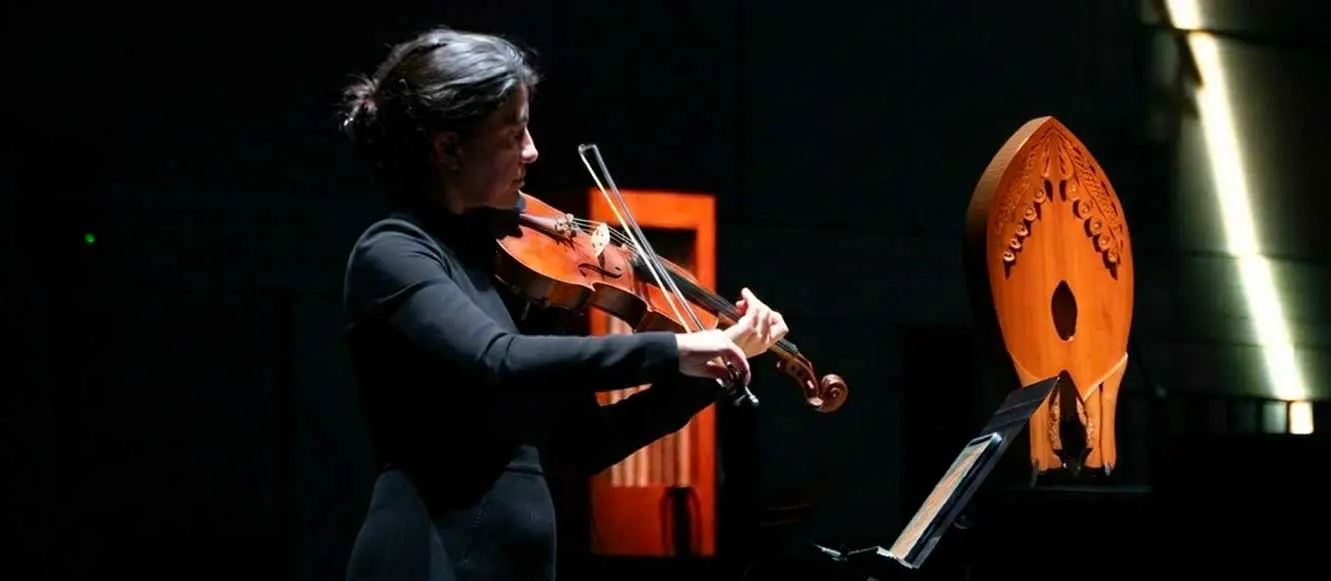

“L’Itinéraire” presents a program for viola and electronics spanning nearly half a century of composition.
From Luis Rizo-Salom’s *Big-Bang* —a nascent cosmos where timbre fragments—to GérardGrisey’siconic*Prologue*, six works explore the voice of the viola in our time, navigating breath, vibration, gesture, and resonance, and extending the tension between instrumental lyricism and processed sound. Camila Agosto’s *Tangent* reflects on the instrument’s texture. Premiered at the Propagations festival, Rodrigo Lima’s Matiz XVII, dedicated to violist Lucia Peralta, draws inspiration from the songs of northeastern Brazil. The electroacoustic works by Ariadna Alsina Tarrés and Marco Suárez-Cifuentes extend this exploration by shifting the focus to the raw material of sound and its ephemeral nature.

Mentions
Production
: The Journey
Supportedby
DRAC Île-de-France; Île-de-France Region; Spedidam; Maison de la Musique Contemporaine
In partnership with La Friche la Belle de Mai
Biography(s)
Lucia Peralta
Viola Player
A passionate performer committed to promoting the music of her time, violist Lucia Peralta joined L’Itinéraire in 2001. Since then, she has performed on the most prestigious stages dedicated to new music, participating in a vast number of world premieres, both as a soloist and as part of the ensemble.
In 2013, she took on the role of artistic coordinator, working alongside composer Grégoire Lorieux. In September 2024, she became artistic director, bringing both continuity and renewal to the ensemble’s artistic vision.
Lucia Peralta also collaborates with numerous leading ensembles, such as Le Balcon and the Ensemble Intercontemporain, reinforcing her commitment to contemporary music.
At the same time, she pursues a career in historically informed performance, performing with prestigious ensembles such as Les Arts Florissants, La Chambre Philharmonique, Les Talens Lyriques, and the Orchestre des Champs Elysées around the world. An accomplished chamber musician, she is also a recognized teacher, holding a teaching certificate.
A graduate of the Paris Conservatory (CNSM), she furthered her studies at the Menuhin Academy in Switzerland.
Marco Suarez-Cifuentes
Composer
Marco Suárez-Cifuentes is a Colombian composer and researcher, and a professor at the Romainville Conservatory. He develops interdisciplinary projects integrating music, science, and technology. Trained at the Javeriana University in Bogotá, the CNSMDP, Ircam, and the Royaumont Foundation, he specializes in the interactions between acoustic, instrumental, and electroacoustic spaces. With a PhD in Arts and Creation (SACRe-PSL), he continued his research at Ircam (ISMM - EAC), at ZKM - Hertz-Labor, and, since 2020, at LadHyX at École Polytechnique, in collaboration with Jean-Marc Chomaz, where he held a postdoctoral fellowship supported by the Arts and Sciences Chair (2021–2022).Active since 1996, he has collaborated with ensembles such as the Ensemble Intercontemporain, Le Balcon, L’Itinéraire, Arthaus, and VorteX. Supported by institutions such as the Ministry of Culture and Communication, Sacem, the Singer-Polignac Foundation, Ircam, Radio France, and IDARTES, he has produced works in Colombia with the Nova et Vetera agency, including *Monologue pour une araignée mécanique* (2016), REVELO (2017–2025), and*De Natura Communis* (2024–2025), for four instrumental ensembles and orchestra.
His six-act opera, REVELO, inspired by the Book of Revelation and conceived with the artist Nieto, has been presented internationally. The complete version, including the acts Aves and Voix Tonnerre, written thanks to the Mondes Nouveaux program of the Ministry of Culture and Communication, will be premiered by Le Balcon under the direction of Maxime Pascal. His current projects include Vulgaris Fictio, an instrumental septet commissioned by the French Ministry of Culture; ARC’, a film-concert in collaboration with Nieto; Mascarets, for voice and six musicians, commissioned by L’Itinéraire; andFive Black Rivers: Ganges from the Arts & Sciences cycle, in collaboration with JM Chomaz.
Camila Agosto
Composer
Camila Agosto is a composer, interdisciplinary artist, and teacher. Her recent work and research are inspired by concepts related to memory, perception, psychoacoustics, and somatic experience. Her electroacoustic music examines how we perceive sounds and vibrations, exploring their physiological, mental, and emotional impacts. In her work, Camila collaborates with musicians, visual artists, choreographers, and instrument makers, seeking intersections between artistic disciplines. Her compositions include both fully notated works and improvisations, with an emphasis on exploring timbres and textures. She aims to reveal the sonic potential of acoustic instruments while highlighting the human element in live performances. Her projects encompass acoustic and electroacoustic concert works, interdisciplinary collaborations with visual media and dance, installations, and works for fixed media. Narration and storytelling are integral to her work, helping to build worlds and soundscapes that explore complex concepts and create spaces conducive to healing.
Ariadna Alsina Tarrés
Composer
Ariadna Alsina Tarrés studied in Barcelona, Helsinki, Paris, and Geneva. She studied violin at the Liceu Conservatory in Barcelona and sonology at the Catalonia College of Music (ESMUC), where she focused on electroacoustic composition under Luis Naón and Gabriel Brncic. She subsequently studied in Paris (with J.-M. López López, H. Vaggione, Ch. Groult, H. Parra, and M. Matalón). In 2015–16, she completed the IRCAM program and enrolled in the Master’s program in Mixed Music Composition at the Haute École de Musique de Genève, where she studied with Luis Naón, Eric Daubresse, and Michael Jarrell.
She has developed her career as a composer through instrumental, mixed, and electroacoustic music, as well as interdisciplinary projects. She conducted research on the representation of time in mixed music at the University of Paris 8 under the supervision of Makis Solomos and Alain Bonardi. Her music has been performed by, among others, the Ensemble Sillages, Ensemble Diagonal, the OCG, Many Many Oboes, Trio KDM, the Lausanne Vocal Ensemble, the Gavarnie Ensemble, and at festivals such as Forum Wallis, Manifeste, Electrocution, Festival Ensemble(s), Archipel, and Multiphonies-GRM, among others. She has received commissions from Ircam, the Lavaux Classic Festival, the Geneva Chamber Orchestra, and Radio France, among others. She received a special mention from the jury of the Luigi Russolo Prize for her composition Dis-till-action, published on the 2015 Russolo Prize CD. She has received support from the Phonos Grant in Barcelona, the National Council for the Arts of Catalonia, and a residency at the Cité Internationale des Arts in Paris. From 2019 to 2024, she served as an assistant in the composition class at the Geneva Higher School of Music (HEM). She teaches in the Master’s program in Composition and Technologies at the ESMUC in Barcelona. In 2025, she received the Pierre Wissmer-Pulsations Contemporaines Foundation Prize from Sacem.
Rodrigo Lima
Composer
Born in Guarulhos (São Paulo) in 1976, Rodrigo Lima is one of the most prolific composers of his generation. His music has been performed at festivals and concert halls in Brazil, Latin America, Europe, and the United States, including the following festivals: Focus Festival 2017 – Latin American Music, Juilliard School, New York (United States);18th World Saxophone Congress and Festival in Zagreb in 2018 (Croatia); Europalia 2011 International Arts Festival at the Concertgebouw in Amsterdam (Netherlands); the 8th “D'aujourd'hui à demain” Festival of Contemporary Music in Cluny in 2009 (France);the 32ndHavanaFestivalof Contemporary Music in 2019 (Cuba), among others.
In 2008, he was composer-in-residence at the5th International Forum of Young Composers in Paris, with the Ensemble Aleph. In 2015, his workAntiphonas for saxophone and ensemble was premiered at the17th World Saxophone Congress and Festival in Strasbourg. In 2016, the Bordeaux International Arts Festival commissioned him to compose Txury-ò (“Path Where the Sun Goes”) for chamber ensemble, a work premiered by the French ensemble Proxima Centauri. In 2019, Santa Marcelina Cultura commissioned him to compose Sol a Pino for orchestra, a work commemorating the40th anniversary of the São Paulo State Youth Orchestra. In 2021, he was the honored composer atthe 28th“Prof. Abrão Calil Neto” National PianoCompetitionin Ituiutaba, Minas Gerais.
He has received major national and international awards, including:1st Prizeat the “Iberoamericano Rodolfo Halffter de Composición” Competition in 2008 (Mexico);1st Prizeat the 2005 Camargo Guarnieri National Composition Competition, the Funarte Prize for Classical Composition—Rio de Janeiro 2010, and1st Prize at the 2009 Camargo Guarnieri Composition Competition of the Campos do Jordão International Festival...
He began his musical training in Goiânia under the composer Estércio Marquez Cunha, with whom he studied piano and composition. In 2005, he earned his bachelor’s degree in composition from the Department of Music at the University of Brasília (UNB), where he studied with Sérgio Nogueira (composition), Conrado Silva (composition), David Junker (orchestral conducting), and Jorge Antunes (counterpoint). He holds a master’s degree in Creative Processes from IA-UNICAMP, earned under the supervision of composer Silvio Ferraz. He is currently a professor of composition at EMESP – Escola de Música do Estado de São Paulo (São Paulo State School of Music). Rodrigo Lima is a member of the “Sociedad General de Autores y Editores” (SgAe), based in Spain, and his scores are published by Universal Edition (Vienna), Babel Scores (Paris), and the Brazilian Academy of Music.
Gérard Grisey
Composer
Showing an early interest in music, Gérard Grisey made his first attempts at composition at the age of nine. It was in Germany, at the Trossingen Conservatory (1963–1965), that he began his studies in this field, before enrolling at the Paris Conservatory, where he received a classical education (earning degrees in harmony, counterpoint, and fugue—in which he excelled—as well as in music history and piano accompaniment). While attending Olivier Messiaen’s composition class (1968–1972), he studied under Henri Dutilleux at the École normale de musique (1968) and was introduced to electroacoustic techniques by Jean-Étienne Marie (1969).
His stay at the Villa Medici from 1972 to 1974 provided opportunities for significant encounters (with the poet Christian Guez Ricord) and discoveries (the music of Giacinto Scelsi). The seminars led by Ligeti and Stockhausen—and to a lesser extent, Xenakis—which he attended in 1972 as part of the Darmstadt Ferienkurse, reaffirmed his own musical concerns and would have a lasting influence on him.
In 1973, Grisey helped found the ensemble L’Itinéraire, whose mission was to champion, through the quality of its performances, an emerging repertoire with specific demands. Émile Leipp’s acoustics courses at Paris VI (1974–1975) laid the foundation for his scientific approach to the phenomenon of sound. Beginning in 1982, he was actively engaged in teaching, first in Berkeley, California, until 1986, and then at the Paris Conservatoire National Supérieur de Musique, where he taught orchestration and later composition. He died on November 11, 1998, from a ruptured aneurysm.
Luis Rizo-Salom
Composer
In 1998, Luis Rizo-Salom earned a master’s degree in composition from Javeriana University in Bogotá, Colombia. He then continued his studies with Emmanuel Nunes at the Conservatoire National Supérieur de Musique et de Danse in Paris. Interested in computer music and new technologies, he joined the computer science and music composition program at IRCAM in 2005, where he composed*Big Bang* for viola and electronics. This work marked a new phase in his musical career.
Composer-in-residence at the Casa de Velázquez in Madrid between 2005 and 2007, Luis Rizo-Salom has received support from institutions such as the Academy of Fine Arts (Georges Wildenstein Prize), the Nadia and Lili Boulanger Foundation, the Colombian government, the Villecroze Academy, and the Meyer, Tarrazi, and Legs Saint-Paul Foundations. His works have been commissioned by the Ministry of Culture (state commission), the Orchestre Nationale d’Île-de-France, the Festival du Larzac, Sacem, Ircam / Centre Pompidou, Radio France, the Steirichen Kammer Musik Festival, and the Shizuoka Concert Hall (Japan). Awarded prizes at composition competitions (Salabet Foundation Prize (2004), Forum 2002 (Canada), University of Evry, “Paso al Arte” Prize (Colombia), etc.), his works have also been performed by leading ensembles and soloists: Ensemble Intercontemporain, Ensembles Court Circuit, L’Itinéraire, 2e2m, Nouvel Ensemble Moderne, Studio New Music, Remix Ensemble, Orchestre National d’Ile-de-France, Christophe Desjardins, Peter Rundel, Mark Foster, Lorraine Vaillancourt, Jean Deroyer, Pascal Rophé, Sussana Malkki, and Pierre Roullier.
His body of work includes chamber, orchestral, and electroacoustic pieces. His music has been performed at numerous contemporary music festivals in Colombia, France, England, Russia, Austria, Italy, Portugal, Spain, Germany, and Canada.
Location
13003
Marseille
Friche la Belle de Mai (Petit Plateau)
41 Jobin Street13003
Marseille
Prologos
Lucia Peralta, Marco Suárez-Cifuentes
Concert
Sat, May 9, 2026 | 7:00 p.m.
Friche la Belle de Mai (Small Stage)
Duration
approx. 1h00
Prices
Evening Pass €14
Full Price €10
Reduced Price €8

Distribution
Lucia Peralta (L’Itinéraire)
, viola
Marco Suárez-Cifuentes
, computer music producer
Program of works :
Big Bang (2005, 10 min.)
Luis Rizo-Salom
for viola and electronics
Tarrés Fragile (triptych) (2024–25, 7 min.)
Ariadna Alsina
electroacoustic
Matiz XVII (2026, 8–10 min.)
Rodrigo Lima
World premiere
for viola
Tangent (2015, 6 min.)
Camila Agosto
French premiere
for viola and electronics
Micro historical tragedy (2020, 5 min.)
Marco Suárez-Cifuentes
electroacoustic
Prologue (1976, 17 min.)
Gérard Grisey
for viola
version with electronics (2001)
Useful links