 Customize the display
Adjust the colors to ensure sufficient contrast.

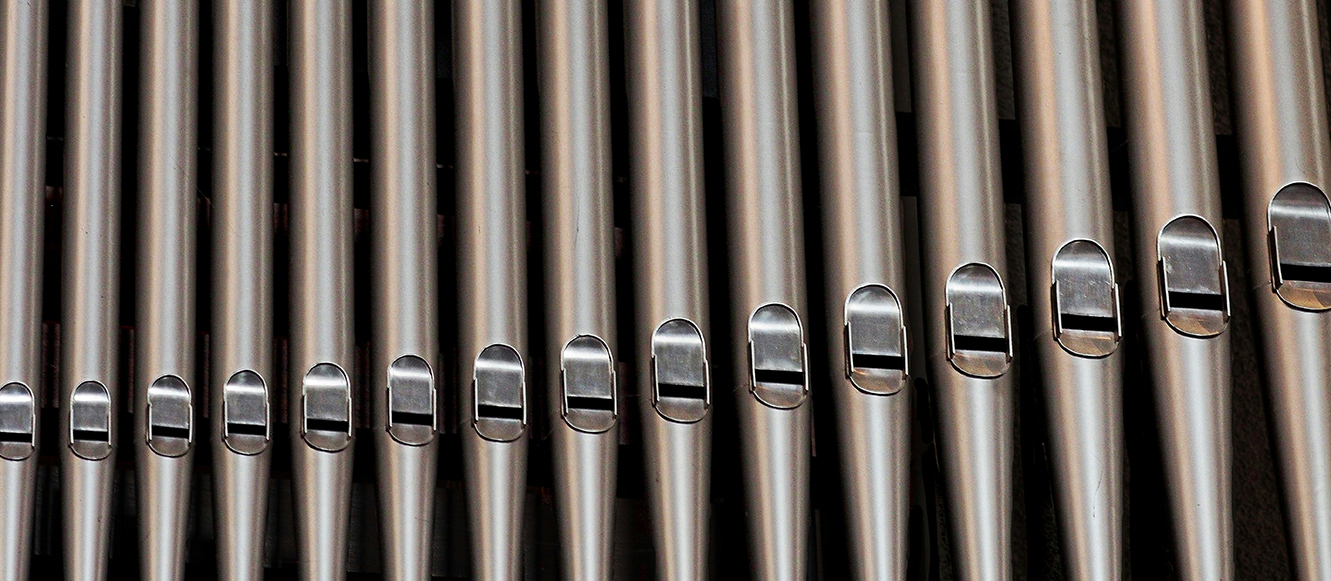

This organ book contains six pieces, all dedicated to Jean Boyer’s “Présence,” with whom Henry Fourès collaborated extensively.
Jean Boyer’s imagination was shaped by the paintings of Ruysdael, in which the wind, the stormy winter skies, and the soft halos of light that bathe the imaginary landscapes invite one to daydream about space, but was also influenced by the writings of Goethe, Rilke, and Thomas Mann.
Each of the six pieces is, above all, the creation of soundscapes, the construction of an invisible architecture.
Georges Boeuf’s *Le départ pour la lune*is one of the first mixed-media works written for organ and electroacoustics. Rediscovered in the archives of the GMEM, of which Georges Boeuf was a founding member, the magnetic tape mixed by the composer in June 1972 was restored and digitized, serving as a valuable testament to the aesthetic of mixed media music from the 1970s.
Performed in 1973 in Cologne, Frankfurt, Marseille, and Avignon, and then in Paris at the Festival d’Automne in 1975, it was also performed on the organ at Saint-Maximin in 1974 and, as a return to its roots, on the organ at Saint-Victor in 1977.
Each piece will be paired with a piece from the repertoire of the performers’ choice.
Mentions
Liber organi
Commission
City of Saint-Maximin-la-Sainte-Baume; Francis and Mica Salabert Foundation
In partnership with the 1stfirst edition of the Saint-Victor Organ Festival, organized by the Cultural Association of the Grand Organ of Saint-Victor (Marseille)
Biography(s)
Henry Fourès
Composer
Born in Coursan (Aude, France), Henry Fourès studied art history at Paul Valéry University in Montpellier, music at the Paris Conservatory (harmony, counterpoint, fugue, analysis, and composition), followed by medieval musicology at the University of Berlin and piano at the Vienna Academy. From 1975 to 1977, he was an intern at the Musical Research Group (GRM INA). From 1977 to 1980, he served as professor in charge of improvised music at the Pantin Conservatory and subsequently taught medieval musicology from 1980 to 1982 at the University of Toulouse-le-Mirail. In 1982, he was appointed Principal Music Inspector at the Directorate of Music and Dance of the French Ministry of Culture, and in 1984, General Inspector in charge of education and training. In 1988, he established the new Department of Creation and Contemporary Music within the Ministry, serving as its technical director until 1990.
As Artistic Director of the creative studio La Muse en Circuit, founded with Luc Ferrari, he subsequently worked regularly in Germany (Potsdam, Berlin, Cologne, Frankfurt, etc.), where he was invited to collaborate with various symphonic ensembles and radio stations. The eclecticism of his work as a composer and performer has led him to collaborate with creators from a wide range of artistic backgrounds and aesthetics (musicians, actors, choreographers, visual artists, filmmakers). His activities span numerous fields. He has directed films for television and composed music for film, dance, and the stage. He is also the author of numerous radio productions (France Culture) and the director of Hörspiel for HR and WDR. He has written symphonic works, chamber music, electronic and mixed-media pieces, and vocal works, as well as designed and produced interactive installations and major events. From 2000 to 2009, Henry Fourès served as Director of the Conservatoire National Supérieur de Musique et de Danse de Lyon. Today, in addition to his work as a composer and performer, he leads seminars at the invitation of European universities. An honorary member of the Hamburg University of Music and Theater, Henry Fourès is an Officer of the Order of Arts and Letters, a Knight of the Order of Merit, and a recipient of the German Cross of Merit (Verdienstkreuz). — www.henryfoures.com
Georges Boeuf
Composer
French composer born in 1937 in Marseille, who died on August 25, 2020, in the same city. It was at the Marseille Conservatory that Georges Boeuf began studying instrumental performance, harmony, and counterpoint. Awarded by Sacem as early as 1966, he was the co-founder of the Marseille Experimental Music Group (GMEM), which was established in 1969. After teaching for several years at the Marseille Conservatory, Georges Boeuf founded a composition class there in 1988. He also founded the Télémaque ensemble, whose repertoire is entirely dedicated to contemporary music.
Georges Boeuf has distinguished himself in a wide variety of musical genres, ranging from electroacoustic music to instrumental music, including mixed and vocal works, as well as pieces for the stage and cinema. His catalog comprises around a hundred works.
He also composed an opera titledVerlaine Paul, based on a libretto by the poet Franck Venaille, which premiered at the Opéra de Nancy on October 29, 1996, with baritone François Le Roux in the title role, and was revived in May 2003 as part of the Propagations festival organized by the GMEM at La Criée — Théâtre national de Marseille, in a new production by Frédéric Bélier-Garcia.
Among his most recent works are: a string quartet premiered by the Quatuor Parisii, *Orbes* for12 strings; premiered by the Royal Orchestra of Wallonia, *Septimo* (1998) for vibraphone and bells, recorded by Frédéric Daumas (*Fragrance*, 1999); Le Prophète, based on a text by Mallarmé, for baritone and piano (1998), premiered by François Le Roux and Alexandre Tharaud at the Grande Bibliothèque in Paris; Solitaire Vigie forlarge orchestra and choir (poem by Mallarmé), premiered in Nancy in January 2000; Variasix forinstrumental ensemble, premiered by the Télémaque ensemble (Aix-en-Provence, 2001); Koré ou L’Oubli forkeyboard-percussion quartet in 2002, premiered by the Symblêma ensemble; Violin Sonata, premieredby Nicolas Miribel;Six Monodies de l’absence fortenor saxophone, premiered by Joël Versavaud; Dans le bruit du monde for choir, premiered by the Roland Hayrabedian Contemporary Choir; Ash Wednesday Mass.
Georg Muffat
Composer
Georg Muffat, born on June 1, 1653, in Megève and died on February 23, 1704, in Passau, was a German composer of Savoyard origin and of Scottish descent through his father. A native of Megève, in the Duchy of Savoy, he was the son of André Muffat and Marguerite Orsy. He studied in Paris with Lully between 1663 and 1669. He was appointed organist in Molsheim and Sélestat, then studied law in Ingolstadt. He later settled in Vienna, Austria (where he likely rubbed shoulders with Kerll), but was unable to secure an official position there. He was in Prague in 1677, then in Salzburg, serving the archbishop for over a decade—where his colleague was Heinrich Biber. In the 1680s, he traveled to Italy, studied the organ there with Bernardo Pasquini (who passed on the tradition of Frescobaldi to him), and worked with Arcangelo Corelli.
From 1690 until his death, he served as Kapellmeister to the Bishop of Passau (now in Bavaria), Johannes Philipp von Lamberg.
He had nine children, four of whom were musicians; the most famous among them was Gottlieb Muffat, who would become the Emperor’s organist.
Jehan Alain
Composer
Jehan Alain, born in Saint-Germain-en-Laye on February 3, 1911, and killed in action on June 20, 1940, near Saumur, was a French composer and organist. Born into a family of musicians, he was the eldest of four children.
His father, Albert Alain, an organist, composer, and amateur organ builder, had constructed a home organ, and it was on this instrument—now located in Romainmôtier, Switzerland—that Jehan began playing at the age of 11. Two years later, he was able to stand in for his father, who had recently been appointed titular organist of the main organ at Saint-Germain Church in his hometown.
He was subsequently admitted to the Paris Conservatoire, where he studied under Paul Dukas, Jean Roger-Ducasse, André Bloch, Georges Caussade, and the organist Marcel Dupré, among others. In Dupré’s class, he was a classmate of the Geneva organist Pierre Segond, to whom he dedicated hisVariations on a Theme by Clément Janequin.
His studies at the Conservatoire culminated in first prizes in harmony, counterpoint and fugue, organ, and improvisation.
HisSuite for Organ wasawarded first prize for composition at the Amis de l'Orgue competition in 1936. That same year, he was appointed titular organist at Saint-Nicolas Church in Maisons-Laffitte. In Paris, he served as organist at the Nazareth Synagogue. After his death, Marie-Louise Girod succeeded him shortly after World War II.
Married in 1935 and the father of three children, he was drafted at the start of World War II. Commended for acts of bravery, he joined Captain de Neuchèze’s First Cavalry Groupe Franc and took part in the Battle of the Cadets of Saumur in June 1940. He single-handedly held off a German assault platoon and died in battle at the age of 29.
Throughout his life, he never stopped composing for piano, organ, chamber music, voices (soloists and choirs), and orchestra. His catalog includes more than 140 works. According to Marie-Claire Alain, the composer’s sister, he had composed several pieces for orchestra. Unfortunately, he took the scores with him when he went to war, and they were never recovered after his death in battle.
Jean-Christophe Revel
Organist
Jean-Christophe Revel discovered the organ under the guidance of Jean-Marie Meignien, with a particular focus on historical organs. This may explain why he has since continually sought to contextualize music and history, early music and contemporary works, and why he has spent the past 30 years researching the transmission of musical repertoires and practices over time.
He furthered his studies with Odile Bailleux. His studies culminated in a first prize in organ and advanced studies with a specialization in early music. Under the direction of Georgie Durosoir, he devoted his master’s thesis to the tablature of B. Schmidt the Younger (1607).
His encounter with Jean Boyer and Jean-Charles Ablitzer was also pivotal in the course of his musical career.
A committed chamber musician, Jean-Christophe Revel has had the pleasure of performing with, among others, James Bowman, Josep Cabré, Isabelle Desrocher, William Dongois, Eugène Green, Raphaele Kennedy, Manuel Weber, and Marcel Pérès, as well as with various ensembles. With a curiosity for all musical genres, he works equally in the fields of early music and contemporary music with numerous composers who write for him, such as E. Tanguy, R. Campo, B. Pauset, E. Canat de Chizy, Colin Roche, Grégoire Lorieux, Boris Clouteau, and many others.
For the past 30 years, his collaboration with composer Jacques Lenot has led him to regularly explore new facets of the organ and to imagine an ever-evolving sonic world.
He is regularly invited to perform at numerous festivals, both in France and abroad, and has recorded for France Musique and television.
His recordings are regularly noted by European critics, including Jacques Lenot’s Troisième livre d’orgue, recorded at Royaumont Abbey (L’oiseau prophète), andAndré Raison’s Second livre(Paraty), recorded at Auch Cathedral. Holder of a certificate of proficiency in organ and early music, he serves as the academic director of the Department of Early Music and Historical Performance at the CRR in Paris and teaches basso continuo and early organ repertoire at the PSPBB (Pôle Supérieur Paris-Boulogne-Billancourt). He also directs the Claviers en Pays d’Auch festival, where he is the titular organist of the magnificent Jean de Joyeuse instrument at Sainte-Marie Cathedral. He has just created in Auch (32) the first augmented organ in France with organ builder Jean Daldosso and the company Alterinstruments (Teresa Rosenberg and Alexander Mihalic). Project supported by the Ministry of Culture and its SNI (Innovative Digital Service).
Jean-Pierre Rolland
Organist
Jean-Pierre Rolland pursued his musical studies at the Conservatoire National de Région de Marseille, then at the Conservatoire National Supérieur de Lyon (organ, improvisation), and at the Conservatoire Royal de Musique de Liège (orchestral conducting). A graduate in all three disciplines, he also holds the Certificate of Qualification for the position of Organ Professor.
After teaching the organ as well as individual and group improvisation at the Conservatoire à Rayonnement Régional de Douai from 2001 to 2014, he was appointed organ professor at the Conservatoire Darius Milhaud in Aix-en-Provence.
He has also served as titular organist at the Cathedral of Le Puy-en-Velay and is a member of the organist team at the Saint Éloi Temple in Rouen (United Protestant Church of France).
As a concert artist, he is particularly dedicated to the interplay between the organ and other instruments, within an original repertoire that includes new compositions. In recitals, he enjoys exploring the interplay between composers from different eras, in thematic programs designed to highlight the full range of the instruments used. He is interested in the entire history of music and does not consider himself specialized in any particular area.
He has recorded for Coop Breizh, Arion, Hortus, and Coriolan. His solo album, *La Saveur des Dissonances*, recorded on the historic organ of Saint-Jean-de-Losne (Côte d’Or), as well as the album*Aubes*, dedicated to the works of Robert Pascal, have garnered attention from several music magazines (5 Diapasons, November 2009 and November 2023).
Jean-Pierre Rolland enjoys composing for those around him whenever the opportunity arises for his works to be performed. He composes vocal, chamber, and organ music. His latest work, Géométrie dans l’espace, won first prize at the 2023 Royan-Orgues composition competition and was premiered at Notre-Dame Church in Royan.
Location
13007
Marseille
Saint-Victor Abbey
Saint-Victor Square13007
Marseille
The organ, repertoires
Henry Fourès, Georges Boeuf
Concert
Sun, May 3, 2026 | 5:00 p.m.
Saint-Victor Abbey
Runtime
: 1 hour 15 minutes
Prices: Full price €10
Reduced price €8

Distribution
Jean-Christophe Revel
Jean-Pierre Rolland
organists
Program of works
Toccata No. 7 (1690)
Georg Muffat
Liber organi (2025 — 35 min.)
French premiere
1) Chant éloigné (Rilke)
2) Winterhimmel (Ruysdael)
3) Gong (Rilke)
4) Le coup de soleil (Ruysdael)
5) Nordwind (Ruysdael)
6) Air
Henry Fourès
Variations on a Theme by Clément Janequin (1937)
Jehan Alain
Departure for the Moon (1972 — 13 min. 11)
Georges Boeuf